
Perfect B, Doral FL. | 05.07.26 | 9 min read.
This post is for educational purposes only and does not substitute for personalized medical advice. Microneedling protocols vary based on scar type, severity, skin tone, and individual healing response. Consult a licensed medical provider before beginning any scar treatment.
What Microneedling Actually Does to Scarred Skin
Acne scars are not a surface problem. When an inflammatory breakout damages the dermis, the body repairs the wound by laying down collagen rapidly. That emergency collagen does not organize the same way as healthy skin architecture. The result is a structural deficit below the surface: fibrous tissue that either pulls skin downward, leaves a defined depression, or creates a narrow channel too deep for topical products to address. Understanding this is the starting point for understanding why microneedling works for some scar types and not others.
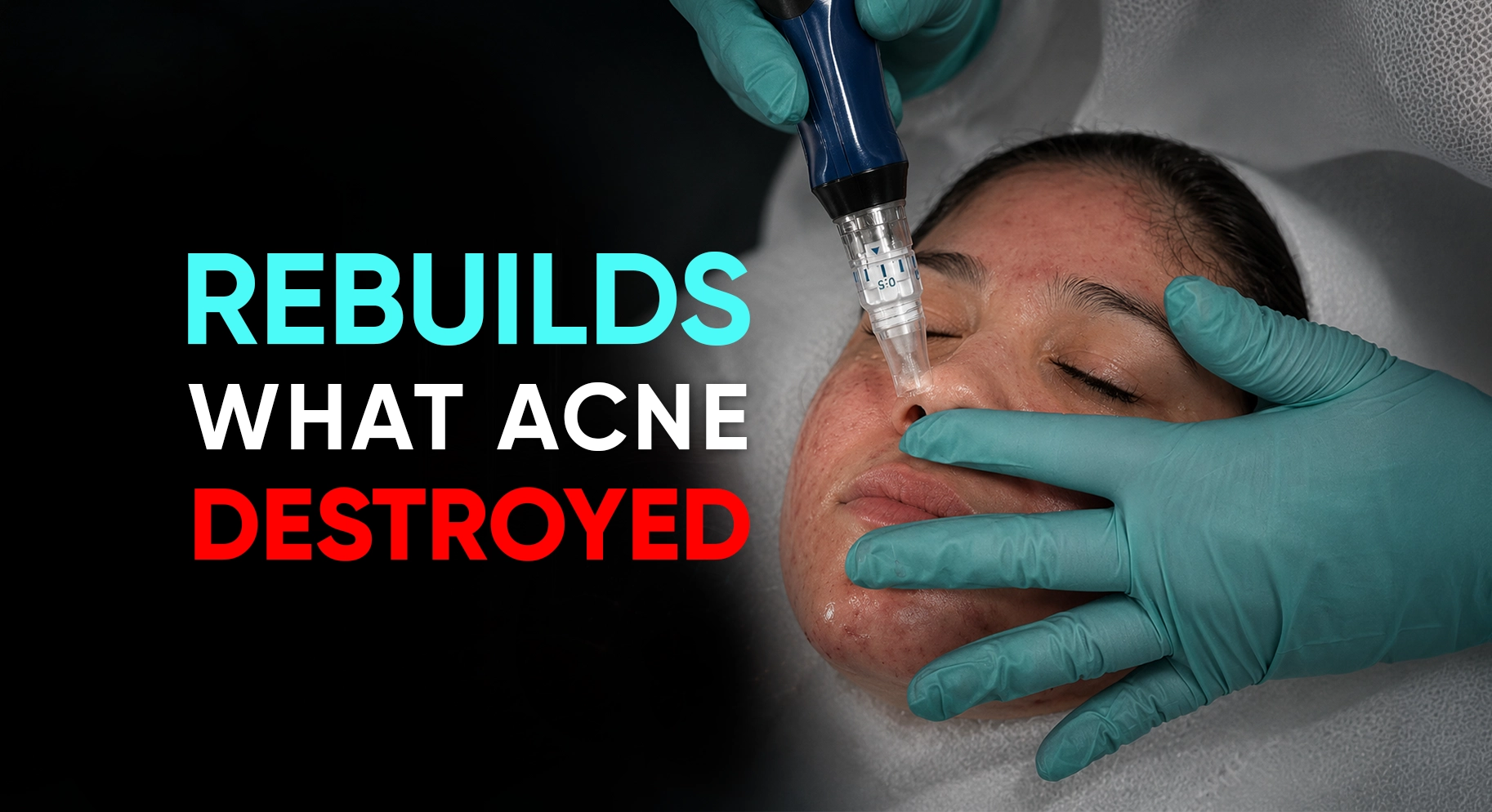
Microneedling, also called collagen induction therapy, creates controlled micro-injuries in the skin using fine needles set at precise depths. Those micro-injuries trigger the body’s natural wound healing cascade. The inflammatory phase, which runs from day one to day three, releases growth factors and cytokines that initiate repair. The proliferative phase, from day four to approximately day twenty-one, drives new collagen and elastin production. The remodeling phase, which can continue for three to six months after a session, reorganizes the new collagen into progressively healthier tissue architecture. Each session resets this cycle, and the cumulative effect of multiple sessions is what produces measurable improvement in scar appearance.
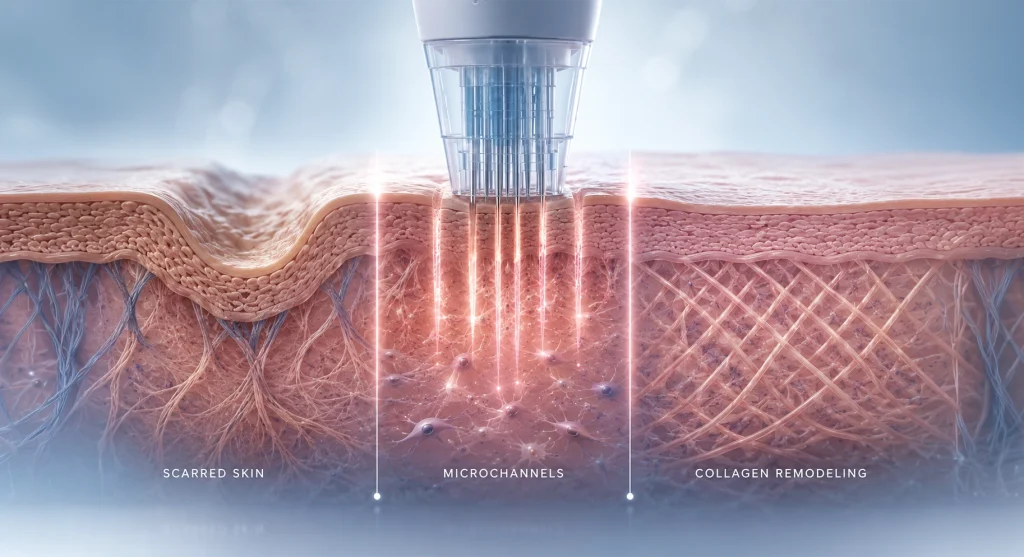
The three-phase wound healing cascade
The inflammatory phase is not a side effect to minimize. It is the mechanism. The redness and minor swelling after a microneedling session are evidence that the healing cascade is activated. Growth factors released during this phase, including platelet-derived growth factor and transforming growth factor beta, signal fibroblasts to begin producing new collagen. The proliferative phase produces new collagen type III, which is gradually replaced by stronger collagen type I during remodeling. Histological studies confirm that after a full series of microneedling, the dermis shows increased collagen density and improved fibril organization compared to baseline.
Why acne scars are a structural problem, not a surface one
Topical products cannot reach the dermis where acne scars originate. The most sophisticated retinol formula, the most potent vitamin C serum, and any over-the-counter treatment for acne marks works at the epidermal level at best. Acne scars are dermis-level injuries. The fibrous bands that tether rolling scars, the defined walls of boxcar scars, and the narrow channels of ice pick scars are all below where topical products can act. Microneedling is effective because the needles physically penetrate into the dermis where the structural problem lives, triggering repair at the correct tissue depth.
Key Takeaways
- Microneedling works by triggering the wound healing cascade at dermis depth, producing new collagen and elastin that progressively improve scar texture and depth over a treatment series.
- Rolling and shallow boxcar scars respond best because their structure is wide enough for the needles to effectively stimulate the surrounding tissue. Ice pick scars require combination approaches because their narrow depth limits what microneedling alone can address.
- The SkinPen is the only FDA-cleared microneedling device with clinical trial data specifically for acne scars. Device selection matters in outcomes.
- Stacking exosomes or PDRN after a microneedling session significantly enhances results because the microchannels created by the needles allow deep penetration of regenerative actives that would not otherwise reach the dermis.
- Most patients need 4 to 6 sessions spaced 4 to 6 weeks apart. Visible improvement typically begins at session 3. Full collagen remodeling continues for three to six months after the final session.
Which Scar Types Respond Best to Microneedling and Which Do Not
Scar type is the single most important variable in predicting microneedling outcomes. The research is consistent on this point. A peer-reviewed clinical study published in the Journal of the Egyptian Women’s Dermatological Society documenting microneedling outcomes across atrophic scar types confirming very good response in rolling and boxcar scars and moderate response in ice pick scars reflects what we observe in practice at Perfect B. Before any treatment plan is written, we identify exactly which scar types are present and in what proportion, because that directly determines whether standard microneedling is sufficient or whether a combination approach is needed.
Rolling scars: the best responders
Rolling scars are broad, shallow depressions that create an undulating, wave-like texture across the skin. Their defining structural feature is fibrous tethering: bands of fibrous tissue beneath the scar pull the skin downward from the dermis. Microneedling addresses rolling scars through two mechanisms. The needle penetration physically disrupts shallow tethering bands near the surface, partially releasing the downward pull. More importantly, the collagen induction that follows fills in the depression from below, raising the scar floor progressively over the treatment series. Rolling scars typically show the most consistent improvement with standard microneedling because the treatment zone aligns well with the scar’s structure. → See Perfect B’s complete guide to acne scar types in Doral, FL, including how we identify and classify rolling, boxcar, ice pick, and hypertrophic scars before building a treatment plan.
Boxcar scars: very good response with layered treatment
Boxcar scars have defined, sharp edges and a flat base. They look like rectangular or oval depressions with vertical walls. Shallow boxcar scars respond very well to microneedling because the flat base provides a wide target area for collagen induction. The sharp edges soften progressively as new collagen fills the scar floor and thickens the dermis surrounding the walls. Deep boxcar scars require more sessions to achieve comparable improvement, and moderate-to-severe deep boxcar scars often benefit from RF microneedling rather than standard treatment, because the radiofrequency energy reaches deeper tissue layers than needle penetration alone.
Ice pick scars: partial response, combination required
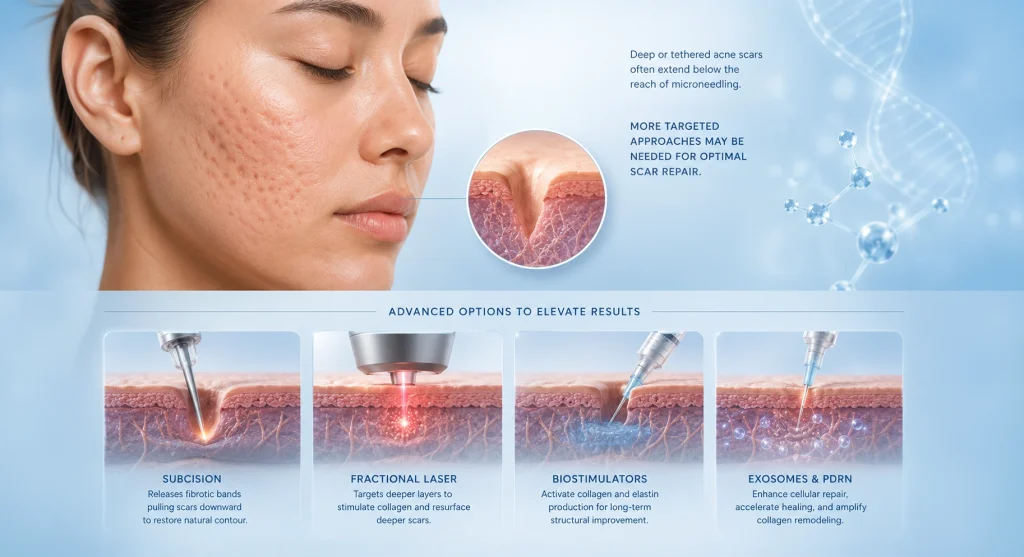
Ice pick scars are narrow, deep, V-shaped channels that can extend through the full dermis and into the subcutaneous tissue. They represent the most structurally challenging acne scar type to treat with any modality. Microneedling produces moderate improvement in the surrounding skin texture and provides some benefit for the superficial portion of the scar channel, but the narrow diameter of ice pick scars limits the degree to which needle-stimulated collagen can fill the channel from within. The honest clinical assessment is that microneedling alone will not resolve deep ice pick scars. Ice pick scars require a targeted intervention that addresses the narrow scar channel directly. At Perfect B, our medical team evaluates each ice pick presentation individually and recommends a protocol based on depth, density, and skin type, often combining Morpheus8 RF microneedling with resurfacing laser for a staged improvement approach.
Post-inflammatory hyperpigmentation: not a scar, but treated alongside
Post-inflammatory hyperpigmentation (PIH) is the flat dark discoloration left after a breakout resolves. It is not structural, it is pigmentary, and it responds differently to treatment. Microneedling accelerates the turnover of pigmented cells and can meaningfully reduce PIH over a series, particularly when paired with depigmenting actives applied post-session through the microchannels. However, the primary driver of PIH improvement is the chemical exfoliation and active delivery component rather than the collagen induction itself. We assess PIH separately from structural scars and address both within the same treatment series when they coexist.
The SkinPen: Why the Device Makes a Difference
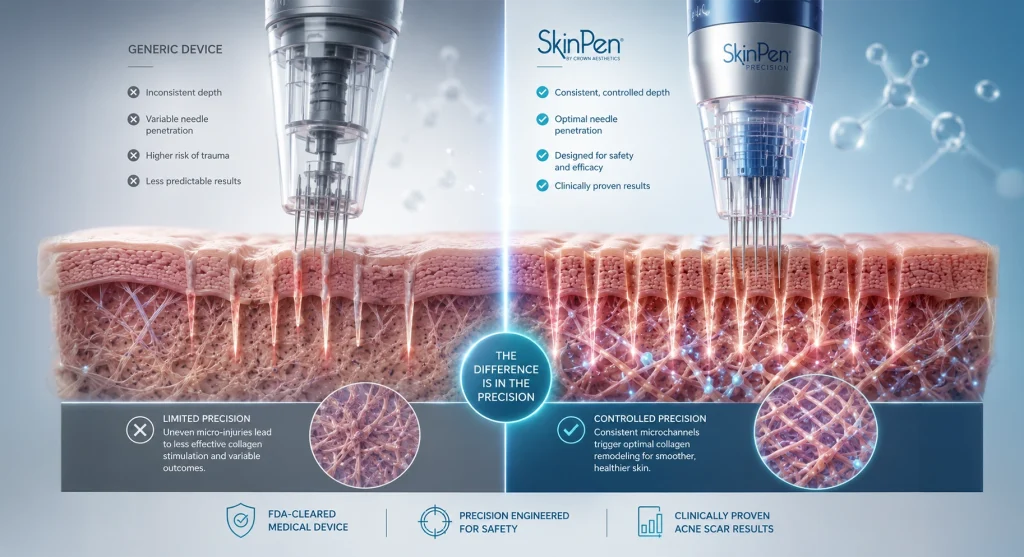
Not all microneedling devices produce the same outcomes. The aesthetics market includes everything from clinical-grade motorized pens to handheld rollers used in spa settings. The depth, speed, needle gauge, and sterility of the device directly affect whether the micro-injuries created are precise and controlled or irregular and potentially damaging.
The only FDA-cleared microneedling device for acne scars
The SkinPen by Crown Aesthetics is the only microneedling device that has completed FDA clearance with clinical trial data specifically for atrophic acne scars and neck wrinkles. That clearance requires demonstrated safety and efficacy in a controlled clinical trial, not just general device safety. At Perfect B, we use the SkinPen because the clinical data is the baseline, not the marketing. Every other variable in our protocol, depth settings, needle speed, skin booster selection, and session timing, is built on top of a device that has earned its clearance through evidence. In a non-medical setting, this distinction rarely exists. Spa microneedling is often performed with devices that are FDA-registered but not FDA-cleared for acne scar treatment. The difference in outcomes is real.
Standard Microneedling vs RF Microneedling (Morpheus8): Which Do You Need?
Standard microneedling creates micro-injuries through mechanical needle penetration alone, stimulating collagen primarily in the superficial to mid-dermis. RF microneedling, which is what Morpheus8 delivers, combines needle penetration with radiofrequency energy delivered at precise depths through insulated needles. The RF energy creates an additional thermal stimulus for collagen remodeling that extends deeper than mechanical stimulation alone and produces more significant tissue contraction and remodeling in the mid-to-deep dermis.
For mild to moderate rolling scars and shallow boxcar scars, standard SkinPen microneedling with exosome or PDRN stacking produces excellent results and is the appropriate starting point. For moderate-to-severe boxcar scars, deep rolling scars with significant dermis-level tethering, or patients whose previous standard microneedling series produced partial results, Morpheus8 RF microneedling is the clinical upgrade. The RF energy reaches the tissue depth where more established fibrosis lives and produces stronger collagen remodeling per session. → See how Perfect B approaches microneedling treatment planning in Doral, FL, including when we recommend SkinPen versus Morpheus8 RF microneedling based on clinical assessment.
How Perfect B Stacks Microneedling: Exosomes and PDRN After Every Session
Standard microneedling produces collagen induction through the wound healing cascade alone. At Perfect B, we consistently stack a regenerative skin booster, either exosomes or PDRN, applied immediately after the microneedling session. The timing and the mechanism are specific and clinically intentional.
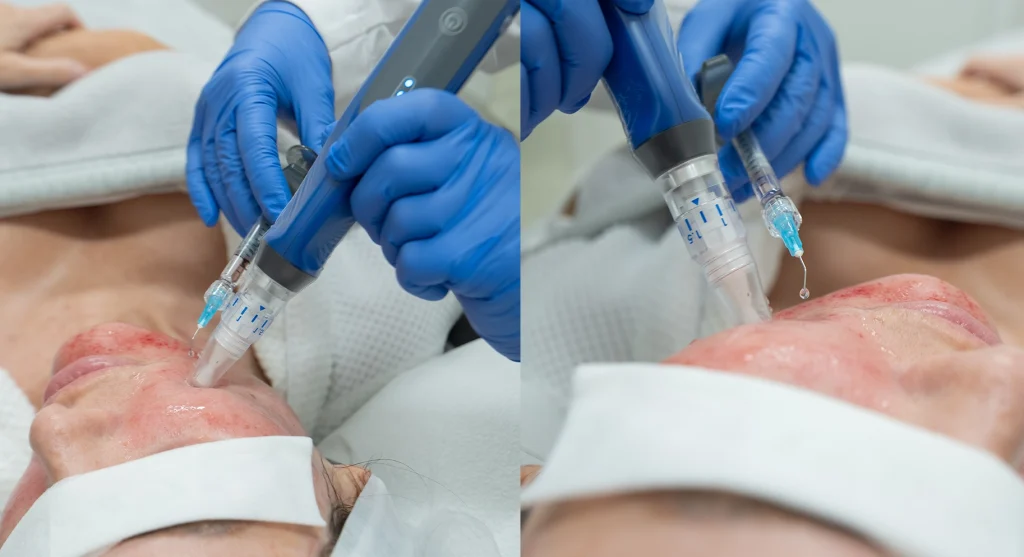
Why skin boosters are applied post-needling, not before
The microchannels created by the SkinPen during a session remain open for approximately four to six hours after treatment. During that window, the epidermis has been transiently perforated, and substances applied to the skin surface can penetrate directly into the dermis rather than being blocked by the intact epidermal barrier. Exosomes applied post-microneedling reach fibroblasts and dermal cells at depth, delivering growth factors and signaling molecules that amplify the collagen induction already initiated by the needle trauma. PDRN, polydeoxyribonucleotide derived from salmon DNA, activates adenosine A2A receptors in the dermis, accelerating tissue repair and collagen synthesis through a pathway that is additive to the wound healing cascade. The result is a stronger collagen stimulus per session than either modality produces independently. For acne scar patients, this means more improvement per session, a shorter overall series to achieve the same outcome, and better results for skin types where conservative needle depths are required.
A peer-reviewed update on microneedling for scars published in Clinical, Cosmetic and Investigational Dermatology confirming that combination microneedling protocols with adjunct regenerative actives produce superior scar improvement compared to microneedling alone supports this approach clinically.
How Many Sessions Does Microneedling for Acne Scars Actually Take?
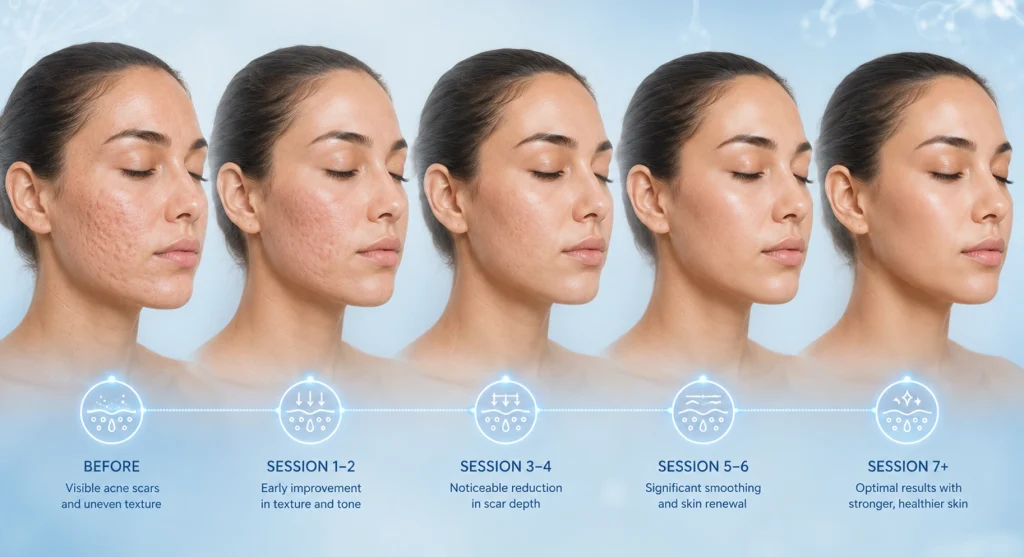
The most direct answer is 4 to 6 sessions for most atrophic acne scar presentations, with sessions spaced 4 to 6 weeks apart. That spacing exists because collagen remodeling requires time. The skin needs to complete the proliferative and early remodeling phases before the next session adds a new collagen stimulus. Shortening the interval does not accelerate results. It reduces the improvement achieved per session and increases the risk of over-treating skin that has not yet completed its repair cycle.
The 4-step framework: Release, Remodel, Resurface, Re-Color
Release: The first priority is addressing any structural tethering. Rolling scars with significant fibrous bands may require subcision before or alongside the microneedling series to release the downward pull. Without addressing the tether, surface-level collagen induction improves texture but cannot fully elevate the scar. For mild rolling scars, microneedling alone is sufficient release.
Remodel: This is the core of the microneedling protocol. Sessions two through four focus on stimulating new collagen and elastin at scar depth, progressively raising the scar floor and softening edges. Exosome or PDRN stacking occurs at every session in this phase.
Resurface: Once structural improvement plateaus, attention shifts to the surface texture. A resurfacing laser or chemical peel refines the top layer, addresses residual irregularity, and improves the overall skin quality around the treated scars. This phase is often where the most visible cosmetic improvement becomes apparent.
Re-Color: If PIH is present alongside structural scars, depigmenting actives and targeted chemical exfoliation address the pigmentary component. This can run concurrently with the remodel phase or follow it, depending on the severity of pigmentation.
What results look like at 3 months vs 6 months
Visible improvement begins to appear after session two or three, typically as a generalized smoothing of skin texture and a slight reduction in scar depth. At the three-month mark following a complete series, most patients with rolling and shallow boxcar scars see meaningful improvement in texture, scar depth, and overall skin quality. By six months, as the collagen remodeling cycle completes, the cumulative improvement is substantially greater than what was visible at three months. Patients who assess their results at four weeks post-treatment and feel disappointed are often comparing against their starting point before the full collagen production cycle has run. We set expectations clearly before treatment begins: the process takes months, and the six-month result looks significantly better than the three-month result.
What Microneedling Feels Like and What to Expect After
Topical numbing cream is applied thirty to forty-five minutes before every session. With adequate numbing, most patients describe the sensation as a vibrating pressure rather than pain. Areas with thinner skin, such as the forehead and around the mouth, can be more sensitive. The procedure typically takes thirty to forty-five minutes for a full face, depending on the areas being treated and the depth settings used.
The healing timeline day by day
Day 1: Redness and minor swelling are normal and expected. The skin will look and feel similar to a moderate sunburn. Avoid touching the face.
Days 2 to 3: Redness begins to subside. Some patients experience minor flaking or dryness as the skin surface renews. Continue using gentle cleanser, moisturizer, and sunscreen only.
Days 4 to 7: Most visible redness is gone. The skin begins to feel smoother as the surface heals. No active skincare products, retinoids, acids, or exfoliants until cleared by your provider.
Weeks 2 to 4: The skin may appear similar to pre-treatment. This is normal. The collagen-building work is happening below the surface, not visibly yet.
Month 2 onwards: Texture improvement becomes visible. Scar depth begins to soften. The full result accumulates over the next several months.
Aftercare in Miami: what to avoid in South Florida
Miami’s UV index and humidity create specific aftercare requirements that patients elsewhere do not face. Freshly microneedled skin has a temporarily compromised barrier and heightened photosensitivity. Sun exposure in the first two weeks post-session is one of the most reliable ways to trigger post-inflammatory hyperpigmentation in darker Fitzpatrick skin types, which describes a significant portion of our patient population in Doral. Our standard aftercare instructions: mineral sunscreen SPF 50 every morning without exception, no beach or pool for two weeks, no high-sweat outdoor activity for one week, and no active skincare products until we confirm the skin has completed its surface healing. → See the complete acne scar treatment protocol at Perfect B in Doral, FL, including how microneedling fits within the full Release, Remodel, Resurface, Re-Color framework for scar correction.
When Microneedling Is Not Enough: What Comes Next
Part of clinical honesty in acne scar treatment is being direct about the limits of any single modality. Microneedling is one of the most effective tools in scar management, but it is not a complete solution for all scar types or all severity levels.
Ice Pick Scars: Why They Need a Different Approach
Ice pick scars present a different structural challenge from boxcar or rolling scars. Their narrow, deep channel means that surface resurfacing techniques produce limited improvement on their own. At Perfect B, our approach to mixed scar presentations involves a staged plan: Morpheus8 RF microneedling and ResurFx laser address the surrounding texture and boxcar component, while the full treatment plan is designed at consultation based on each patient’s specific scar map, skin type, and treatment history.
Subcision for tethered rolling scars
When rolling scars are severe enough that fibrous bands are clearly pulling skin downward, subcision is the appropriate first step before or alongside the microneedling series. Subcision involves inserting a fine needle beneath the scar and sweeping it laterally to physically cut the fibrous tethering band. Once the tether is released, the scar floor is freed from the downward pull and the collagen produced by subsequent microneedling sessions can fill the space from below. Subcision at Perfect B is often performed with Radiesse, a biostimulator injected into the subcised space immediately after the tether is released, providing a scaffold for the new collagen to grow into. This combined approach produces better structural correction than either technique alone.
Frequently Asked Questions
1. Does microneedling completely remove acne scars?
Microneedling significantly improves acne scars but does not eliminate them completely in most cases. Clinical research and our experience at Perfect B consistently show 40 to 75 percent improvement in rolling and boxcar scars over a full series, with some patients achieving near-complete smoothing of mild scarring. Deep ice pick scars and severe boxcar scars require combination approaches for maximum improvement. We set clear, realistic expectations at every consultation so patients know what they are working toward.
2. How many microneedling sessions do I need for acne scars?
Most patients need 4 to 6 sessions spaced 4 to 6 weeks apart. Mild rolling and boxcar scars may respond well in 3 to 4 sessions. Moderate to severe scarring, particularly with mixed scar types, typically requires 5 to 6 sessions or more. The session count is determined at consultation based on scar type, severity, and whether combination treatments like subcision are appropriate alongside the series.
3. Is microneedling safe for darker skin tones?
Yes, when performed with correct depth settings, appropriate needle speed, and proper aftercare. At Perfect B, we assess every patient’s Fitzpatrick skin type before any treatment. For Fitzpatrick III to V patients, which describes the majority of our patient population in Doral, we use more conservative depth settings and consistently apply sun protection aftercare guidance that accounts for Miami’s UV environment. The SkinPen’s precision depth control is a significant advantage for darker skin tones compared to less controlled devices.
4. When will I see results from microneedling for acne scars?
Visible improvement typically begins after session 2 or 3 as a generalized smoothing of skin texture. Meaningful scar depth reduction becomes apparent around the 3-month mark after completing the series. The six-month result is substantially better than the three-month result because collagen remodeling continues for months after the final session. Patience is part of the clinical protocol, not a side note.
5. Can microneedling be combined with other treatments?
Yes, and at Perfect B it always is. We stack exosomes or PDRN after every microneedling session to amplify the collagen induction response. We evaluate ice pick scars at consultation and design the protocol around scar depth and density. We perform subcision before or alongside the series when rolling scars involve significant tethering. After the microneedling series, resurfacing laser or chemical peels address surface texture. Microneedling is most effective as the centerpiece of a multi-modal scar correction plan, not as a standalone treatment.
6. What is the difference between SkinPen microneedling and a spa microneedling treatment?
The primary differences are device certification, depth control, provider training, and protocol design. The SkinPen is the only FDA-cleared microneedling device with clinical trial data for acne scars. Spa microneedling typically uses FDA-registered devices without equivalent clinical evidence for scar treatment. More importantly, scar treatment requires clinical assessment of scar type and depth, which determines the appropriate needle depth and density. A standardized protocol applied uniformly is not adequate for atrophic acne scar correction.
7. Does microneedling hurt?
With proper topical numbing applied 30 to 45 minutes before treatment, most patients describe the sensation as a vibrating pressure rather than pain. Sensitivity varies by treatment area. The forehead and upper lip areas can be more sensitive than the cheeks. Post-session soreness and redness resolve within 24 to 48 hours in most patients.
Closing: What Matters Most Before You Start
Microneedling for acne scars is one of the most clinically supported scar correction tools available, and at Perfect B it is also one of the most refined. The outcomes we achieve are not a result of the microneedling alone. They come from the assessment that precedes it, the device that performs it, the skin boosters stacked after it, and the realistic expectations set before it begins.
Scar type determines outcome potential. Session count follows from scar type. Protocol design follows from both. If you have been exploring options for acne scar treatment and want to understand specifically what your scar presentation requires, a consultation is the correct starting point. We will tell you exactly which scar types you have, which treatment approach fits your skin, and what realistic improvement looks like for your specific case.
📍 Visit us at Perfect B, Doral FL
📞 Call or message us at (786) 502-2260