
Perfect B, Doral FL. | 05.13.26 | 10 min read.
This content is for educational purposes only and does not substitute professional medical advice. Consult a licensed medical provider before starting any aesthetic treatment.
PDRN vs Dermal Fillers: How Salmon DNA Treatment Actually Differs
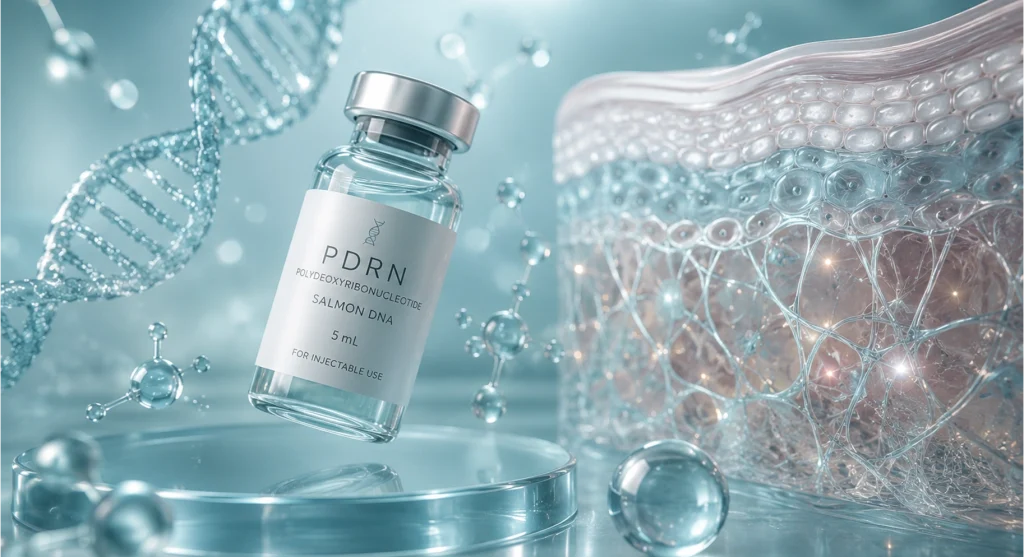
PDRN and dermal fillers are frequently compared, but they solve different problems through opposite mechanisms: fillers add volume by sitting under the skin, while PDRN prompts the skin to regenerate its own collagen and tissue. PDRN stands for polydeoxyribonucleotide, a regenerative compound derived from the DNA of salmon. It is not a skincare trend. It is a molecule that has been used in clinical medicine for over four decades, originally for wound healing and tissue repair, before making its way into aesthetic medicine as a skin booster and injectable treatment.
The reason salmon DNA is used specifically comes down to biocompatibility. Salmon DNA shares a high degree of structural similarity with human DNA, which allows PDRN to integrate into skin cell signaling pathways without triggering an immune response. In K-beauty, PDRN became widely recognized through Rejuran Healer, a Korean injectable product that brought the ingredient to international attention. At clinics like Perfect B in Doral, FL, PDRN is now offered as an injectable treatment for patients seeking regenerative skin rejuvenation without the volume-adding effect of traditional fillers.
Key Takeaways
- PDRN is a DNA-derived regenerative compound, not a filler. It stimulates your skin’s own repair mechanisms rather than adding volume.
- Dermal fillers add immediate volume and lift. PDRN stimulates progressive structural regeneration. They serve different clinical goals.
- The head-to-head is not about which is better but about which matches your skin goals, timeline, and starting condition.
- South Florida patients with darker skin tones often benefit from PDRN over certain fillers due to lower risk of post-inflammatory hyperpigmentation.
- PDRN injectable results typically appear at 4 to 6 weeks and continue improving through 12 weeks, unlike fillers which are visible immediately.
How PDRN Works: The Adenosine A2A Pathway Explained
The fibroblast activation mechanism
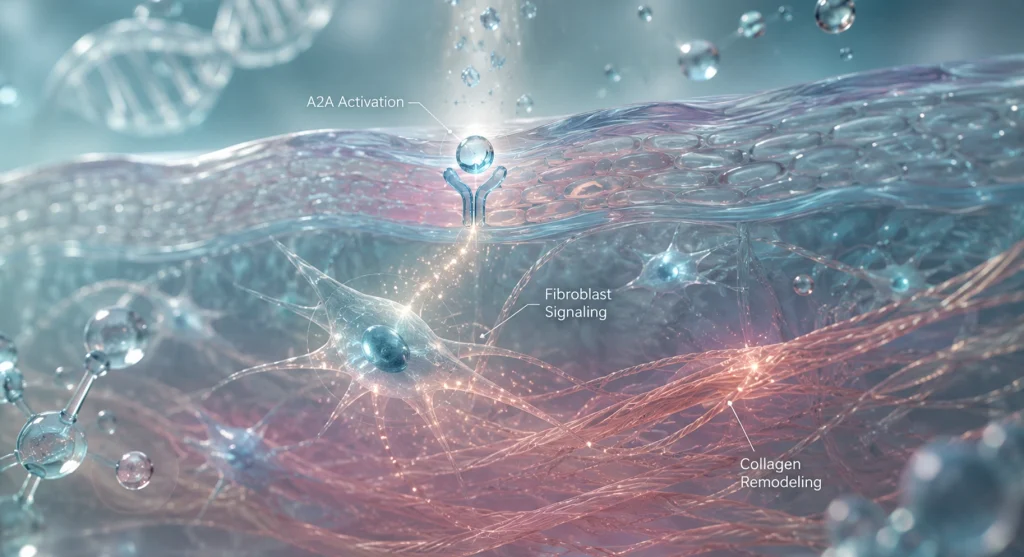
PDRN acts primarily as an adenosine A2A receptor agonist. When PDRN molecules bind to these receptors on fibroblasts, the cells responsible for producing collagen and elastin, they trigger a cascade of regenerative activity. Fibroblast proliferation increases, collagen synthesis accelerates, and the extracellular matrix, the structural scaffolding of the dermis, begins to rebuild.
This is a fundamentally different mechanism from what hyaluronic acid fillers do. Fillers physically occupy space in the tissue, creating volume from the outside. PDRN instructs your skin’s own cells to produce structural proteins from the inside. The peer-reviewed pharmacological review of PDRN published in Frontiers in Pharmacology, cited by over 227 studies, documenting its tissue-repairing, anti-ischemic, and anti-inflammatory properties establishes this mechanism as clinically validated, not theoretical.
PDRN injectable vs topical: why the delivery method matters
One of the most common points of confusion in the current PDRN conversation is the difference between topical and injectable PDRN. Topical PDRN serums, which now appear in many K-beauty products, deliver real benefits at the surface level, including barrier support, anti-inflammatory effects, and mild hydration. But PDRN’s regenerative mechanism requires the compound to reach fibroblasts in the dermis, which topical application cannot consistently achieve.
Injectable PDRN bypasses the epidermal barrier entirely and deposits the compound directly in the target tissue. The results from injectable PDRN, including measurable increases in dermal thickness, collagen density, and elasticity, come from this direct delivery. At our clinic, we administer PDRN as an injectable skin booster in a series of sessions tailored to the patient’s skin goals.
The 5 Clinically Documented Benefits of PDRN for Skin
1. Tissue regeneration and wound healing
PDRN’s original and most well-established application is tissue repair. By activating A2A receptors and stimulating fibroblast activity, PDRN accelerates the natural healing process. In aesthetic medicine, this translates to faster recovery from procedures, improvement in post-acne scarring, and restoration of skin that has been damaged by chronic sun exposure.
2. Collagen and elastin stimulation
As fibroblasts proliferate in response to PDRN, they produce both type I and type III collagen, as well as elastin. The result over a series of sessions is measurably improved dermal thickness, reduced fine lines, and skin that resists deformation more effectively. Unlike fillers, which provide volume without changing the collagen architecture, PDRN improves the structural quality of the dermis itself.
3. Anti-inflammatory effects
PDRN suppresses the production of pro-inflammatory cytokines including TNF-alpha and IL-6. For patients with rosacea-prone or reactive skin, this anti-inflammatory action is a significant clinical benefit. Dermal fillers do not have this property and in some patients can temporarily increase inflammation at the injection site.
4. Hydration at the structural level
Unlike hyaluronic acid, which draws water into the tissue temporarily, PDRN improves the skin’s intrinsic capacity to retain moisture by strengthening the extracellular matrix. The hydration effect is not immediate but is more durable because it reflects an actual improvement in skin architecture rather than temporary water displacement.
5. Skin texture and tone improvement
Patients undergoing PDRN treatment at Perfect B consistently report improvements in skin texture, pore size, and overall tone beginning around the 4-week mark of their protocol. These are the effects that have driven the ingredient’s popularity in K-beauty and are now increasingly documented in peer-reviewed aesthetic medicine literature. A relevant study on PDRN’s role in dermal regeneration and GLP-1 receptor activation, published in the International Journal of Molecular Sciences, supports its application in aesthetic medicine.
PDRN vs Dermal Fillers: How They Actually Differ
This is the comparison that most patients research before choosing a treatment, and the one where most online content oversimplifies the answer. PDRN and dermal fillers are not interchangeable alternatives. They address different clinical problems and produce different results.
What dermal fillers do
Hyaluronic acid fillers work by physically adding volume to a specific area. They are injected into precise locations, including the cheeks, lips, jawline, and under-eye hollows, where the gel displaces tissue and creates lift. The effect is visible immediately and lasts between 6 and 18 months depending on the product, the location, and the patient’s metabolism. Fillers do not stimulate collagen, do not improve skin quality, and do not address inflammation.
What PDRN does
PDRN does not add volume. It instructs the skin to rebuild. Results are progressive, becoming visible at 4 to 6 weeks and continuing through the 12-week mark. PDRN is indicated when the clinical goal is skin quality improvement: texture, tone, elasticity, hydration depth, and reduction of fine lines. It is not the right choice when the patient needs structural volume replacement.
Head-to-head: mechanism, timeline, candidacy, longevity
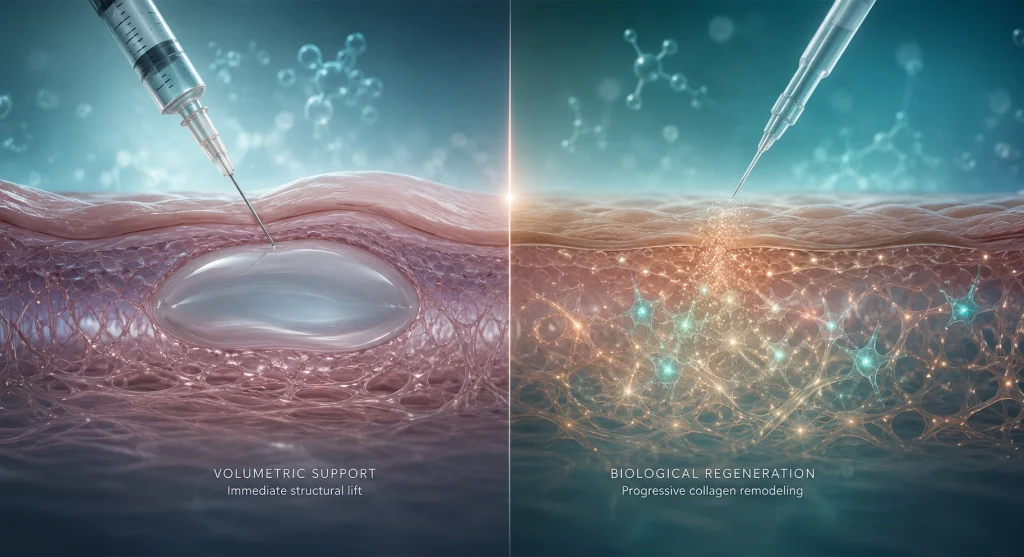
When to choose PDRN, when to choose fillers, and when to combine them
- Choose PDRN when: the goal is skin quality (texture, tone, elasticity), the patient has reactive or darker skin, the priority is natural progressive results, or post-procedure recovery time must be minimal.
- Choose fillers when: structural volume loss is the primary concern, the patient needs an immediate visible result, or specific anatomical areas (cheeks, lips, jawline) require targeted lift.
- Combine both when: the patient has both volume loss and skin quality concerns. At Perfect B in Doral, we commonly use PDRN as the foundation of a skin quality protocol alongside fillers for patients who have both needs. The treatments are fully compatible and can be performed in the same session or in planned sequences.
PDRN for Darker Skin Tones: Why It Matters in South Florida
At our Doral clinic, the majority of our patients have Fitzpatrick skin types III through VI. This demographic context changes how we evaluate injectable treatments significantly.
Certain dermal fillers, particularly those placed superficially or in areas with thin skin, carry a higher risk of post-inflammatory hyperpigmentation and vascular events in darker skin tones. The Tyndall effect, a bluish discoloration that can occur with superficially placed HA fillers, is more visible and harder to correct in patients with deeper pigmentation.
PDRN does not carry these risks. Because it works by stimulating the skin’s own cellular activity rather than introducing a foreign volume, there is no displacement effect, no risk of Tyndall, and the anti-inflammatory properties of PDRN actively reduce the likelihood of post-treatment hyperpigmentation. For South Florida patients, particularly those with Fitzpatrick IV and V skin, PDRN represents a regenerative option that aligns well with the specific skin safety considerations of this population.
What to Expect from PDRN Treatment: A Session-by-Session Timeline
Session 1 through 2 (weeks 1 to 4): foundation
During the first two sessions, PDRN begins activating fibroblast activity in the dermis. Most patients notice improved skin hydration and reduced redness within the first two weeks. Visible texture changes are not yet prominent at this stage. Some patients experience mild swelling or redness at injection sites that resolves within 24 to 48 hours.
Week 4 to 6: first visible changes
By the 4-week mark, most patients begin to notice changes in skin quality: smoother texture, reduced pore appearance, and a more even baseline glow. Fine lines in areas of repeated facial expression show early softening. This is when patients who expected filler-like immediate results can misread the timeline, so setting accurate expectations before treatment begins is part of our protocol.
Week 8 to 12: full regenerative effect
The full clinical benefit of a PDRN protocol becomes visible between 8 and 12 weeks. At this stage, dermal collagen density has measurably increased, skin elasticity improves, and the overall quality of the skin is substantially better than at baseline. For patients with acne scarring or post-inflammatory marks, this is the window where the most significant texture improvement occurs. Maintenance sessions every 3 to 6 months sustain these results.
PDRN at Perfect B in Doral: How We Use It and Who It Is For
At Perfect B’s PDRN therapy program in Doral, FL, we approach every PDRN protocol with a full skin evaluation that includes skin type assessment, Fitzpatrick classification, treatment history, and the patient’s specific goals. PDRN is not appropriate for every patient and it is not a universal answer to every skin concern.
We recommend PDRN for patients who want to improve overall skin quality, reduce the appearance of fine lines and texture irregularities, address post-acne scarring, or prepare their skin for a larger aesthetic procedure. It works particularly well for patients who have been considering fillers but are not ready for volumization, or who want to start with a regenerative approach before committing to a structural correction.
For patients with questions about how PDRN compares to PRP at our Doral clinic, we address the full spectrum of regenerative options including PDRN, PRP, and exosome-enhanced protocols in individual consultations. The right regenerative approach depends on the clinical picture, not a universal ranking of treatments.
Our full PDRN before and after results at Perfect B in Doral, FL provide a realistic picture of what patients with different skin types and starting conditions can expect from a full protocol.
Frequently Asked Questions
1. What does PDRN do for the skin?
PDRN activates adenosine A2A receptors on fibroblasts, which stimulates collagen and elastin production, reduces inflammation, and supports tissue repair. The clinical result is improved skin quality including better texture, elasticity, hydration depth, and tone. It does not add volume and it does not produce immediate visible results the way fillers do.
2. Is retinol or PDRN better for anti-aging?
They work through different mechanisms and are not direct substitutes. Retinol increases cellular turnover and stimulates collagen through retinoic acid receptor activation. PDRN stimulates fibroblast proliferation and extracellular matrix repair through the A2A receptor pathway. For patients who cannot tolerate retinol, particularly those with reactive or sensitive skin, PDRN offers a gentler regenerative alternative. Many patients benefit from both in a coordinated protocol.
3. What are the downsides of PDRN?
Injectable PDRN requires multiple sessions before full results are visible, which makes it a poor fit for patients who need an immediate result. It does not correct structural volume loss. Topical PDRN produces more modest results than injectable PDRN. Side effects from injectable PDRN are generally mild and temporary, including redness, swelling, and bruising at injection sites, but any injectable treatment carries a small risk of adverse events when not performed by a trained provider.
4. What are the side effects of PDRN?
The most common side effects of injectable PDRN are mild and localized: temporary redness, swelling, and bruising at the injection sites. These typically resolve within 24 to 72 hours. Allergic reactions are rare due to the high biocompatibility of salmon DNA with human biology. Serious adverse events are uncommon when PDRN is administered by a licensed provider in a medical aesthetics setting.
5. How many PDRN sessions are needed?
Most patients start with a protocol of 3 to 4 sessions spaced 2 to 4 weeks apart. The first visible results typically appear around the 4-week mark. Full results are assessed at 12 weeks after the initial protocol. Maintenance sessions every 3 to 6 months sustain the collagen and elastin improvements. The exact number of sessions depends on the patient’s skin goals and starting condition.
6. Can PDRN and dermal fillers be done at the same time?
Yes. PDRN and dermal fillers can be performed in the same session or in a planned sequence. They are fully compatible and address different aspects of skin aging: PDRN improves skin quality and dermal architecture, while fillers restore volume and structural lift. At Perfect B in Doral, we frequently combine both for patients who have both skin quality and volume concerns. Call us at (786) 502-2260 to discuss whether a combination approach fits your goals.
7. Is PDRN safe for darker skin tones?
PDRN is particularly well-suited for patients with darker skin tones (Fitzpatrick IV through VI). Its anti-inflammatory properties reduce the risk of post-inflammatory hyperpigmentation, and unlike superficially placed fillers, PDRN does not carry a risk of Tyndall effect discoloration. At our Doral clinic, where the majority of patients have Fitzpatrick III through VI skin, PDRN is one of our most recommended regenerative options for this population.
Closing: The Clinical Bottom Line on PDRN in South Florida
PDRN is not a replacement for dermal fillers and it is not a superior alternative. It is a different category of treatment that addresses a different clinical problem. Fillers replace volume. PDRN rebuilds skin quality. When patients understand this distinction, the decision between them becomes less confusing and more precise.
At Perfect B in Doral, FL, Valeria Marulanda guides every PDRN consultation with a full evaluation of the patient’s skin history, tone, goals, and realistic timeline. If you are in South Florida and researching whether PDRN, fillers, or a combination of both fits your current skin picture, that conversation starts with a proper clinical assessment, not a generic treatment menu.
📍 Perfect B | 8200 NW 41st St, Suite 100, Doral, FL 33166
📞 (786) 502-2260