Perfect B, Doral Fl. | 07.14.26 | 11 min read.
This article is for general educational purposes and is not a substitute for an in-person medical evaluation. Peptide therapy is prescribed and administered by a licensed medical provider, and any compounded medication is dispensed through a regulated pharmacy. Candidacy, sourcing, and protocols vary from person to person, and your plan is confirmed at a personal consultation.
Are Compounded Peptides Safe? The Honest Answer Depends on the Source
If you are asking whether compounded peptides are safe, you are asking the right question, but the honest answer is that it depends almost entirely on where the peptide comes from and who is overseeing it. A peptide compounded by a licensed pharmacy under a prescription and administered by a medical provider is a fundamentally different thing from a vial labeled “research use only” bought from a website. Both may contain a peptide, but only one sits inside a regulated, supervised chain of custody, and that difference is the whole story.
This guide explains what “compounded” actually means, how the United States Food and Drug Administration regulates the pharmacies that make these medications, what separates a trustworthy compounded peptide from a gray-market one, and why a prescription and a provider are not bureaucratic hoops but the core of what keeps the treatment safe. The goal is to help you tell the difference, because in this category the label on the vial is not enough.
Key Takeaways
- Safety depends on the source: a peptide compounded by a licensed pharmacy under a prescription is not the same as an online “research use only” vial.
- Compounding is regulated: compounding pharmacies operate under FDA and state oversight through the 503A and 503B framework, not in a vacuum.
- Compounded is not the same as FDA-approved: compounded medications are not approved finished products, so safety comes from the regulated pharmacy plus provider supervision, not a stamp on the vial.
- Gray-market vials are the real risk: “research use only, not for human use” products carry no guarantee of identity, purity, or sterility, and no provider.
- A prescription and a provider are the point: evaluation, correct dosing, and ongoing monitoring are what make peptide therapy genuinely safe.
What “Compounded” Actually Means
Compounding is the practice of a licensed pharmacy preparing a medication tailored to an individual patient, rather than dispensing a mass-manufactured product straight off a shelf. It exists for legitimate reasons: a patient may need a specific dose, a combination, or a form that is not commercially available. A compounded peptide, then, is a peptide prepared by a compounding pharmacy to fill a prescription written by a licensed provider for a specific person.
In the United States, compounding happens under two federal categories. A 503A pharmacy compounds for an individual patient based on a specific prescription, while a 503B outsourcing facility compounds larger batches under stricter manufacturing standards. Both operate under defined oversight. The key point is that a real compounded peptide is made to order inside a regulated pharmacy, which is worlds apart from a bulk powder sold online to anyone with a credit card.
How the FDA Regulates Compounding Pharmacies
Here is the nuance that trips people up: a compounded medication is not an FDA-approved product in the way a mass-manufactured drug is. That does not mean it is unregulated. Compounding pharmacies operate under a combination of FDA and state board of pharmacy oversight, and the FDA maintains rules about which substances may and may not be compounded. Those lists are reviewed and can change over time, which is exactly why a legitimate provider only works with what is currently permitted and appropriately sourced.
So the safety of a compounded peptide does not come from an approval stamp on the vial. It comes from the regulated framework the pharmacy works within, plus the medical supervision on top of it. For the official rules, the United States Food and Drug Administration’s official questions and answers on human drug compounding, which explains how 503A pharmacies and 503B outsourcing facilities are regulated is the authoritative reference. A source that cannot point to any of this framework is the source to worry about.
What Makes a Compounded Peptide Trustworthy
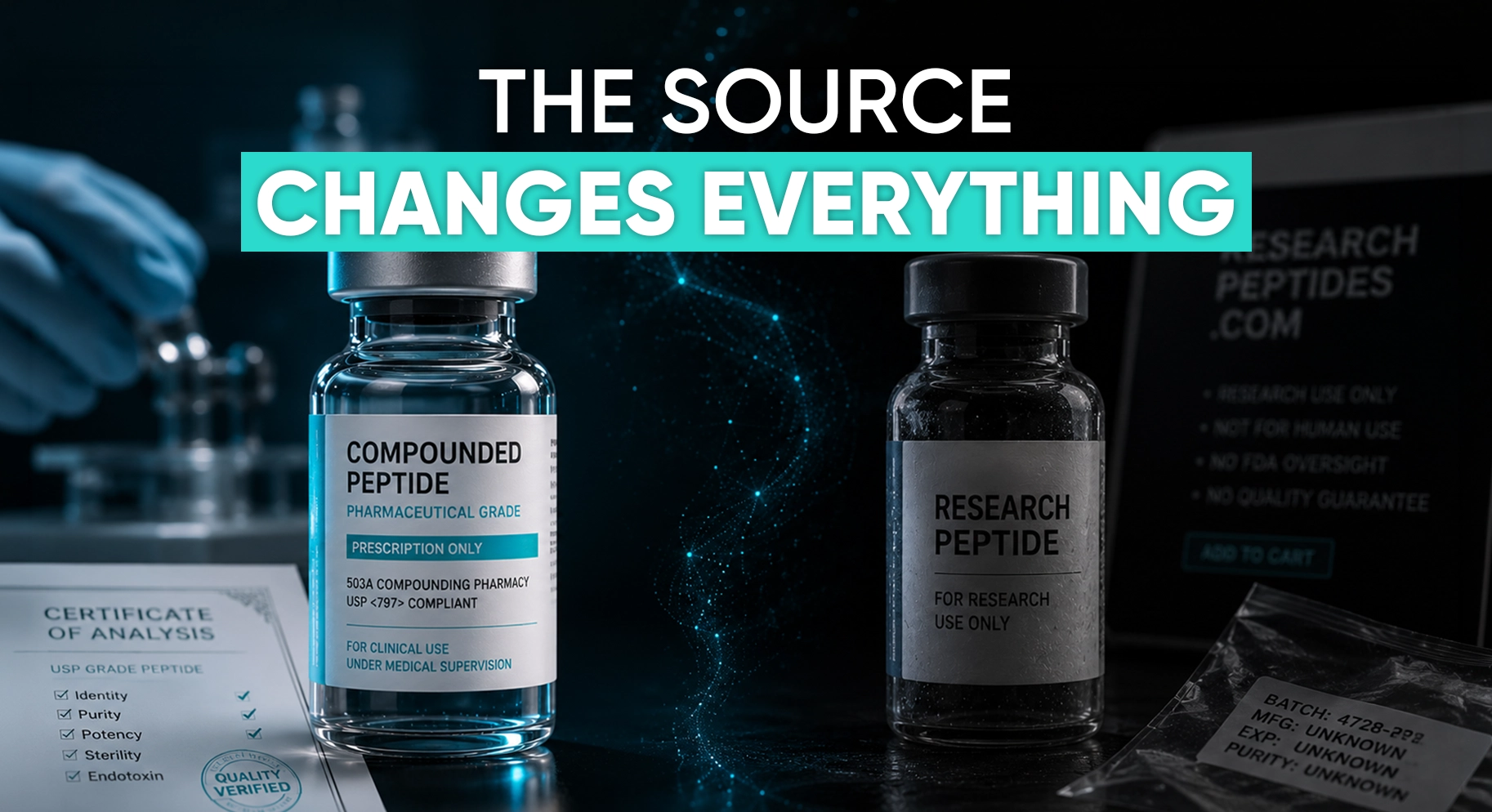
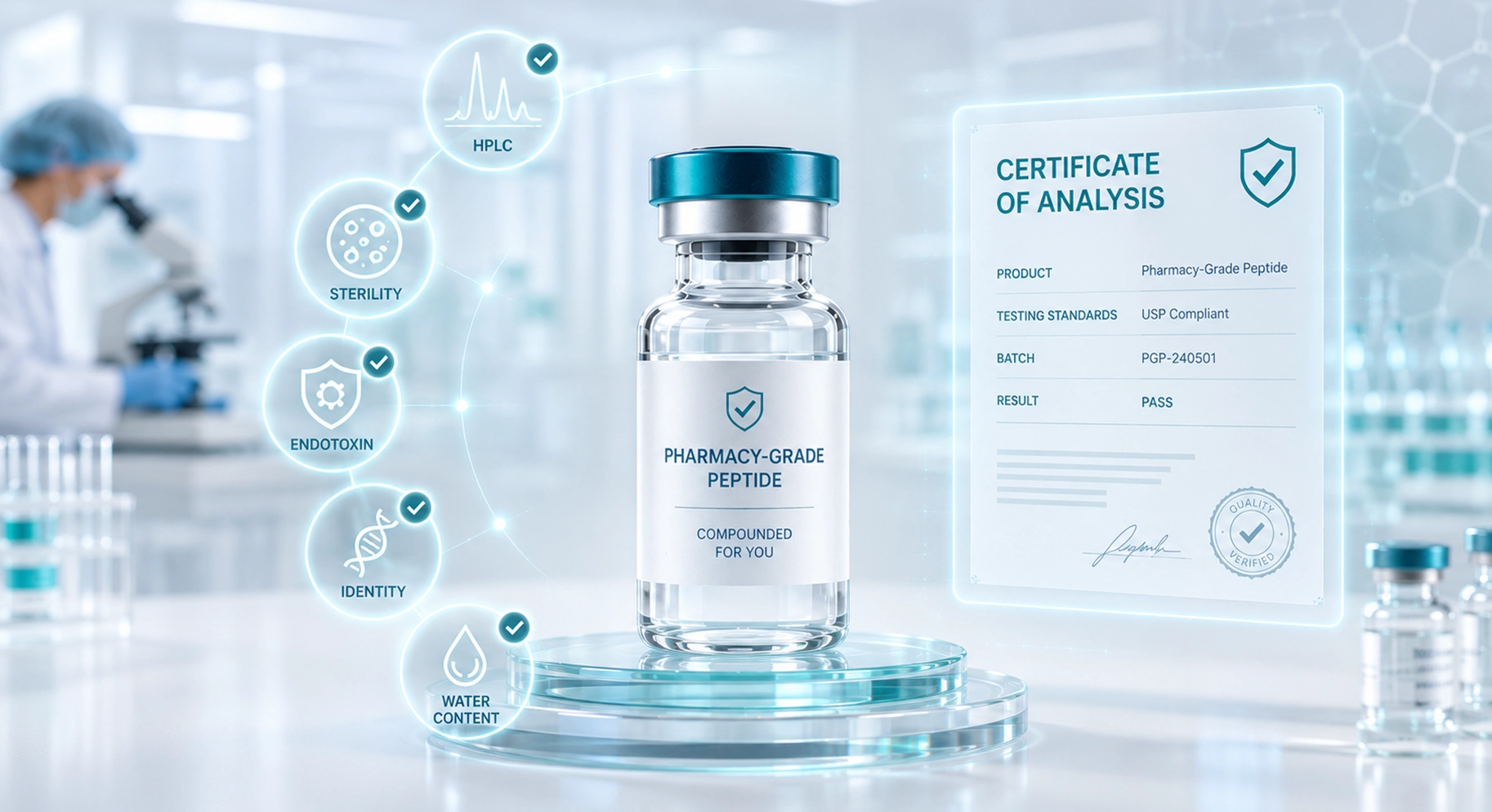
A trustworthy compounded peptide can be traced. The pharmacy sources its raw material from verified suppliers, prepares it in a sterile environment built to pharmacy standards, and can produce a certificate of analysis that documents the identity, purity, potency, and sterility of what is in the vial. Those are not marketing words; they are the specific checks that tell a provider the medication is what it claims to be and is safe to administer.
This is the practical difference you can actually ask about. A legitimate treatment can answer where the peptide came from, how it was tested, and how it should be stored and used. A gray-market vial cannot answer any of those questions, because there is no accountable party behind it. When the chain of custody is documented from raw material to prescription, the risk drops dramatically.
The Gray-Market “Research Use Only” Problem
The peptides that give the whole category a bad name are the ones sold online as “research use only” or “not for human consumption.” That labeling is not a technicality; it is the seller’s way of stepping outside the rules that protect patients. These products are not made to be injected into people, carry no verified identity, purity, or sterility, and come with no provider, no dosing guidance, and no accountability if something goes wrong.
If you want the full comparison, our breakdown of compounding pharmacy peptides versus online research peptides, and why the regulated pharmacy route protects you in ways an online vial simply cannot lays it out side by side. The same caution applies to informal sources, which is why we also explain the risk of getting peptides from personal trainers or other non-medical sources, where there is no prescription, no oversight, and no way to verify what you are actually injecting. A lower price never offsets an unknown vial.
Why a Prescription and a Provider Change the Safety Equation
A prescription is not paperwork for its own sake. It means a licensed provider has evaluated whether the treatment is appropriate for you, reviewed your health history and medications, chosen a correct dose, and taken responsibility for your care. That evaluation catches the reasons a peptide might be a bad idea for a specific person, which no website can do. The prescription is the doorway to the regulated supply in the first place.
The provider relationship also continues after the first vial. You have someone to ask about technique, side effects, and whether the plan is working, and someone accountable for adjusting it. That continuity is the difference between a supervised medical treatment and a self-directed experiment with an unknown substance, and it is a major part of what the word “safe” actually means here.

Red Flags That a Peptide Source Is Not Safe
You do not need to be a pharmacist to spot an unsafe source. A few red flags reliably separate a regulated treatment from a risky one, and any single one of them is reason to walk away.
- “Research use only” or “not for human consumption” labeling: this is the clearest sign the product is not meant to be injected into people.
- No prescription required: if anyone can buy it with a credit card and no evaluation, there is no medical oversight.
- No certificate of analysis: a source that cannot document identity, purity, and sterility cannot tell you what is in the vial.
- No provider behind it: a trainer, an influencer, or a website is not a licensed prescriber and carries no accountability.
- Price that seems too good: unusually cheap peptides usually mean cut corners somewhere in sourcing, testing, or sterility.
Safety Is Also About Ongoing Monitoring
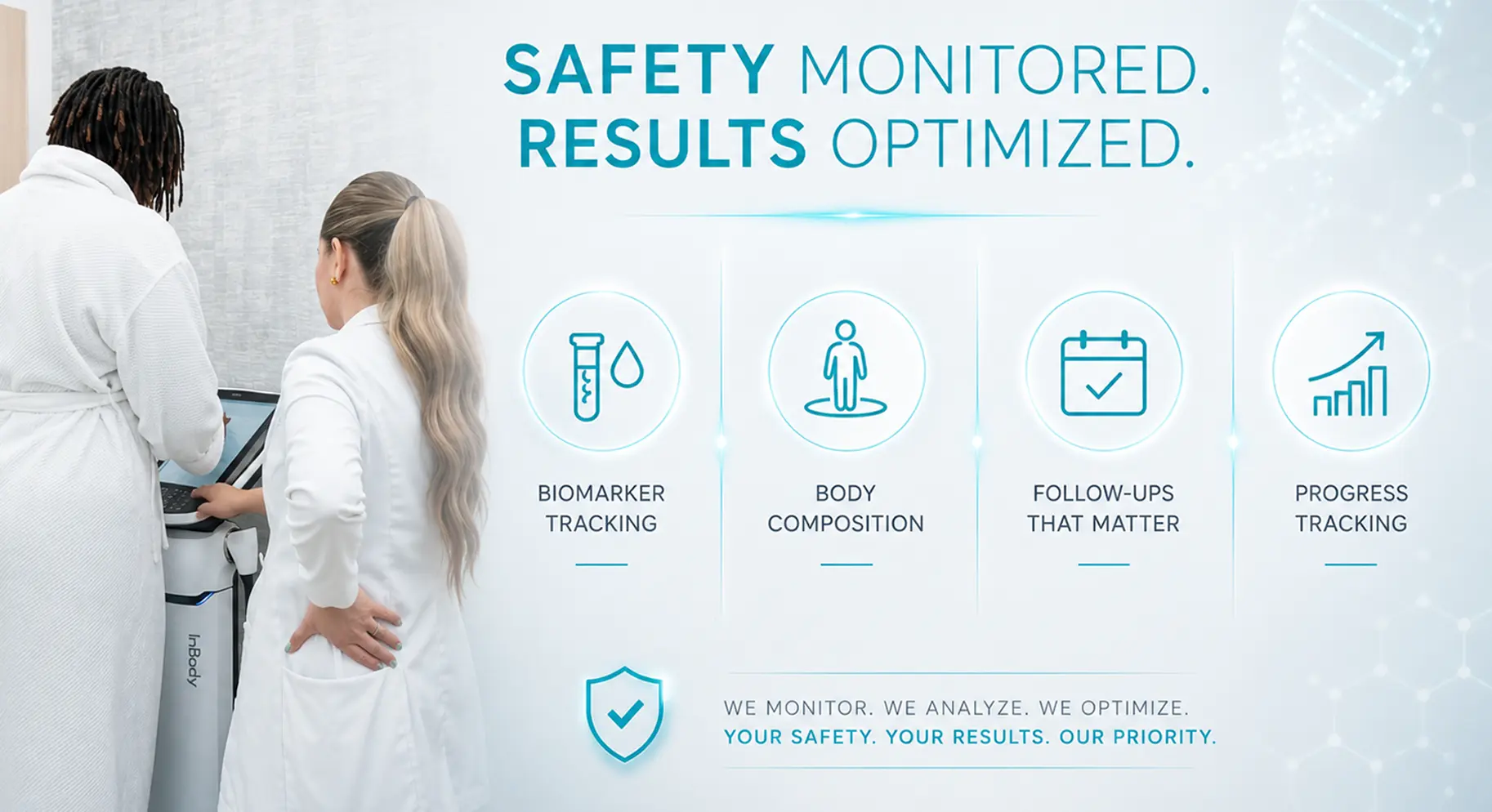
Even with a properly compounded peptide and a prescription, safety is not a one-time event. Responsible peptide therapy includes follow-up, so a provider can check how you are responding, watch for side effects, and adjust or stop the plan if needed. This is the part that self-sourcing removes entirely, because there is no one tracking your response or catching a problem early.
Monitoring is what turns a treatment into a plan. It is also why buying online to “save the consultation fee” is a false economy: you are not just skipping a cost, you are removing the safeguard that exists to protect you. The oversight is the product as much as the peptide is.
How Perfect B Handles Compounded Peptides Safely
At Perfect B, peptide therapy runs through the regulated route from start to finish. A licensed provider evaluates whether a peptide is appropriate for you, writes the prescription, and the medication is prepared through a licensed compounding pharmacy rather than pulled from an online cart. You are dosed, guided, and followed by a provider, which is the entire point of doing it correctly rather than cheaply.
If you want the broader safety picture, read our detailed explainer on whether peptides are safe, covering side effects, candidacy, and how supervised therapy is designed to protect you, and to see how it all fits together, our supervised peptide therapy program for Miami and Doral patients explains how evaluation, prescribing, and monitoring work as one coordinated medical plan. That coordination is what makes the answer to “are compounded peptides safe” a confident yes when it is done right.
Frequently Asked Questions
1. Are compounded peptides safe?
They can be, when the peptide is compounded by a licensed pharmacy under a prescription and administered with provider supervision. Safety depends on the source and the oversight, not the word “peptide” on the label. An online “research use only” vial is a very different and far riskier thing.
2. Are compounded peptides FDA-approved?
Compounded medications are generally not FDA-approved finished products in the way mass-manufactured drugs are. Instead, compounding pharmacies operate under FDA and state oversight through the 503A and 503B framework. The safety comes from that regulated system plus medical supervision rather than an approval stamp on the individual vial.
3. What is the difference between compounded and research peptides?
A compounded peptide is prepared by a licensed pharmacy to fill a prescription for a specific patient, with documented sourcing and testing. A research peptide is sold online, often labeled “not for human use,” with no prescription, no verified purity or sterility, and no provider behind it. Only one is meant for medical use.
4. Do I need a prescription for compounded peptides?
Yes. A 503A compounding pharmacy prepares a peptide based on a prescription from a licensed provider for a specific patient. If a source lets you buy without any evaluation or prescription, that is a sign you are dealing with a gray-market product rather than a regulated compounded medication.
5. Why are online peptides so much cheaper?
Because they skip everything that costs money and protects you: verified sourcing, purity and sterility testing, a licensed pharmacy, a prescription, and provider oversight. The lower price reflects cut corners, not a better deal, and the savings disappear quickly if you inject something you cannot verify.
6. How do I know if a peptide source is legitimate?
A legitimate source requires a prescription, works through a licensed compounding pharmacy, can provide a certificate of analysis, and has a licensed provider responsible for your care. If any of those are missing, or you see “research use only” labeling, treat it as unsafe and walk away.
7. Is a certificate of analysis important?
Yes. A certificate of analysis documents the identity, purity, potency, and sterility of the peptide, which is how a provider confirms the vial actually contains what it claims and is safe to administer. A source that cannot produce one cannot tell you what you would be injecting.
8. Does Perfect B use compounded peptides?
Perfect B runs peptide therapy through the regulated route: a provider evaluates you, writes the prescription, and the medication is prepared through a licensed compounding pharmacy, with dosing and monitoring handled by the provider. That supervised chain is what keeps the treatment safe from the first vial onward.
Get Peptides the Safe, Supervised Way at Perfect B
If you are considering peptide therapy, the safest and smartest step is an evaluation with a licensed provider who can tell you whether it is appropriate for you and handle the sourcing, dosing, and monitoring correctly. At Perfect B in Doral, peptide therapy runs through a regulated compounding pharmacy and a supervised medical plan, never through an online cart. You get the treatment done properly, not just cheaply.
Reach out to start the conversation, ask your questions, and let a licensed provider design a supervised peptide plan built around your goals and your safety.
- 📍 Visit us at Perfect B, 3905 NW 107th Ave, Suite 104, Doral FL 33178
- 📞 Call or message us at (786) 502-2260
- 💳 Financing available through Cherry, Klarna, Afterpay, and CareCredit