Perfect B, Doral Fl. | 06.18.26 | 13 min read.
This article is for educational purposes only and does not constitute medical advice. Laser tattoo removal is a medical procedure with documented risks, including scarring, pigment changes, and incomplete clearance. Outcomes depend on individual factors that must be assessed in person by a licensed clinician. Consult a qualified medical provider before starting any laser treatment.
Key Takeaways
- A real laser tattoo removal consultation in Doral assesses Fitzpatrick skin type, Kirby-Desai score, ink color map, prior treatment, and complication protocols before pricing.
- The most predictive factor for safety is who operates the laser and under whose medical supervision, not which device the clinic owns.
- Most Doral and Miami patients fall in Fitzpatrick III-V, which changes wavelength selection, fluence settings, and the realistic risk of post-inflammatory hyperpigmentation.
- The Kirby-Desai six-factor score predicts how many sessions a tattoo will need before clearance, and you should leave with yours written down.
- If a clinic quotes a monthly payment before a total cost, will not name the laser device, or has no written complication protocol, walk away.
Why a Real Laser Tattoo Removal Consultation Is Not a Sales Pitch
In Miami and Doral, the gap between a franchise laser bar and a supervised medical clinic shows up in the first ten minutes. At a franchise chair, the person across from you opens with a monthly payment, a package deal, and a guarantee of how many sessions you will need. At a supervised medical clinic, the conversation starts with your skin, your ink, your medical history, and your photographs. Price comes last, after the clinician knows what your tattoo will actually require. That is the difference between a sales script and a clinical workup, and also the difference between a predictable outcome and a complication you did not consent to.
This guide gives you the ten tattoo removal questions to ask in any clinic in Doral, Miami, or anywhere in South Florida. If the answers are vague, defensive, or pivot back to pricing, you are sitting in a spa chair. We use this framework at our supervised laser tattoo removal program at Perfect B in Doral, and we will walk you through what good answers sound like and what should make you walk out.

Question 1: Who Will Physically Operate the Laser on Me, and What License Do They Hold?
The first of the high-value tattoo removal questions is the simplest: who fires the laser. In Florida, laser tattoo removal is regulated as the practice of medicine, which means the device may only be operated by a licensed physician, by an advanced practice registered nurse or physician assistant working under a supervising physician’s protocol, or by an electrologist within their defined scope. An unlicensed technician operating a medical laser without delegated authority is operating outside the law. If the clinic cannot give you a name and a license, end the visit.
At Perfect B in Doral, every session is performed by an advanced practice registered nurse working under a supervising medical director’s written protocol, with the same clinician handling your laser tattoo removal consultation, your first tattoo removal session, and every follow-up. That continuity matters because each session adjusts based on how your skin responded to the last one. Read what defines a supervised medical laser tattoo removal clinic in Doral and South Florida for the licensing details Florida patients should verify.
Question 2: Which Laser Device Do You Own, and Is It FDA Cleared for Tattoo Removal?
The second of the core tattoo removal questions is about hardware. Ask the clinic to name the specific device by manufacturer and model, and ask whether it holds a current FDA 510(k) clearance for tattoo removal. If the answer is a brand you cannot find on the FDA database, or a generic description like “our laser,” that is a problem.
The honest answer to what laser is best for tattoo removal depends on the colors in your tattoo, your Fitzpatrick type, and the depth of the ink. Q-switched Nd:YAG platforms deliver 1064 nm for dark ink on dark skin and 532 nm for red and warm colors. Picosecond systems like the PicoWay, PicoSure, or PiQo4 shorten pulse duration and tend to clear stubborn ink in fewer sessions. No single device covers every color and every skin type. See the FDA 2023 consumer update on laser tattoo removal, the cleared devices, and the documented risks of incomplete removal and scarring for the regulatory baseline.
Question 3: What Is My Fitzpatrick Skin Type, and How Does That Change Your Settings?
The Fitzpatrick scale grades skin from Type I, which always burns and never tans, through Type VI, which is deeply pigmented and rarely burns. Doral and greater Miami are predominantly Fitzpatrick III, IV, and V because the population is heavily Latino, Caribbean, and South American. That demographic reality is the most important variable in the room. Higher Fitzpatrick types carry a documented risk of post-inflammatory hyperpigmentation when fluence is set too aggressively or when the wrong wavelength is used.
A clinician should classify your Fitzpatrick type in front of you, explain why darker skin generally requires 1064 nm Nd:YAG rather than 532 nm for black ink, and walk you through conservative fluence settings. They should also discuss sun exposure four weeks before and after every session, because tanned skin shifts your effective type upward. A clinic that says “we treat everyone the same” does not understand the South Florida patient population.
For the device-level reasoning, read a complete explainer of how laser tattoo removal works at the cellular level with wavelength and ink color logic.
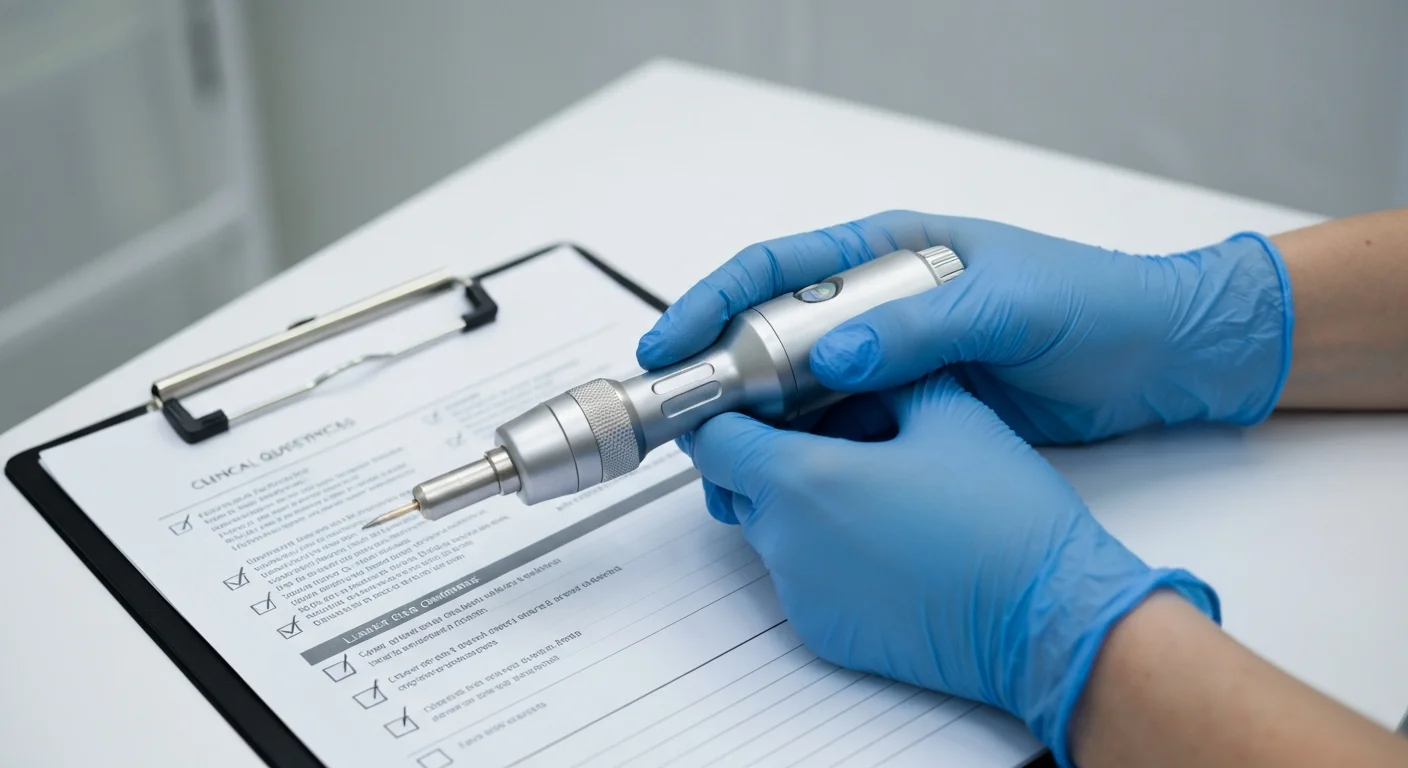
Question 4: What Is My Kirby-Desai Score, and How Many Sessions Will My Tattoo Realistically Need?
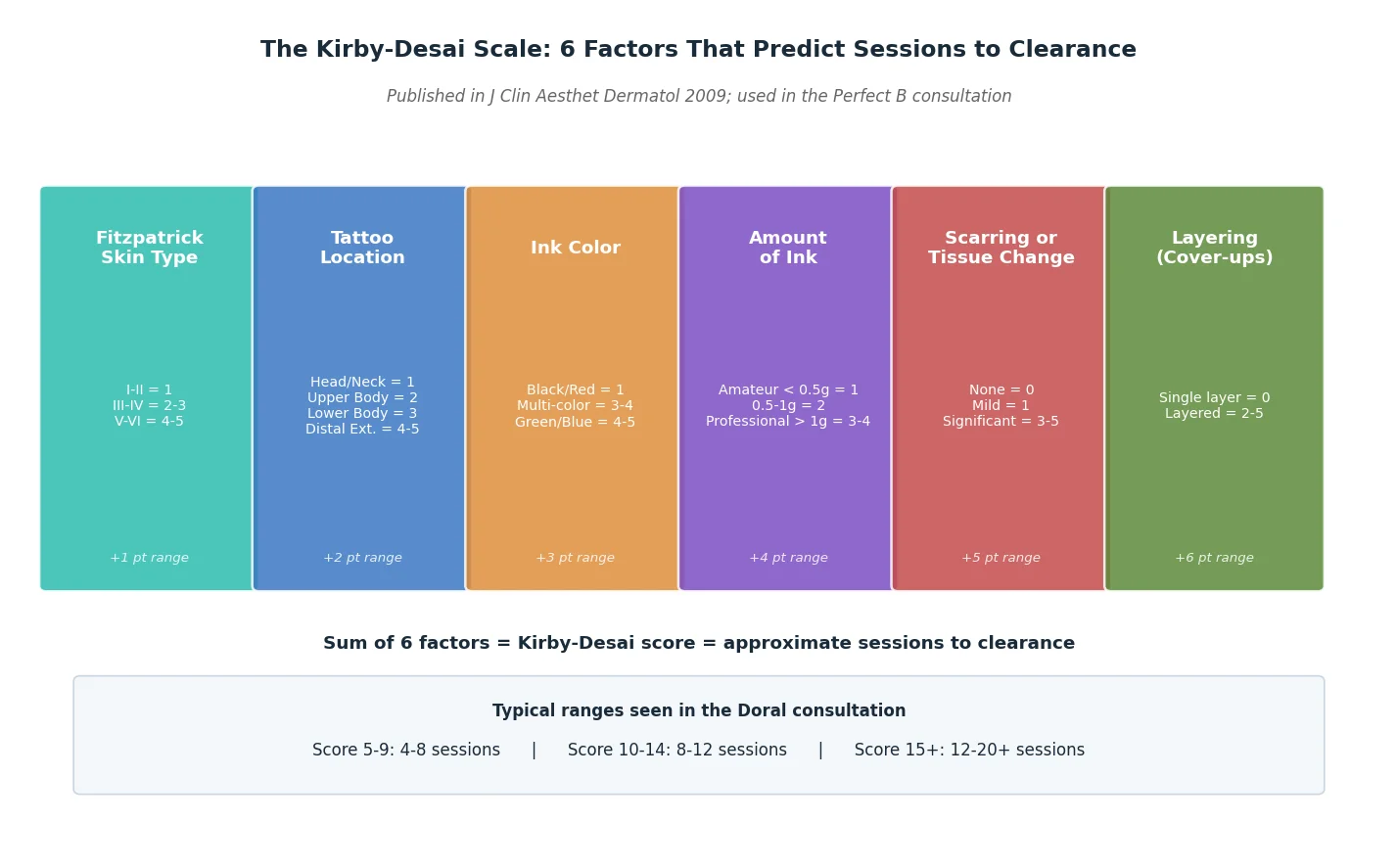
The Kirby-Desai scale is the only validated clinical instrument for predicting how many sessions a tattoo will need before clearance. Published in J Clin Aesthet Dermatol in 2009, it sums six factors: Fitzpatrick type, body location, ink color, ink amount, scarring, and layering from cover-ups. The total, roughly 5 to 20, correlates with predicted sessions. Read the 2009 Kirby-Desai paper in J Clin Aesthet Dermatol that introduced the validated six-factor score to predict sessions to clearance for the original methodology.
The marketing line “most tattoos clear in 8 to 12 sessions” is a population average that often does not apply to the individual in the chair. A small, black, amateur tattoo on a Fitzpatrick II patient might clear in 5 to 6 sessions. A multi-color, layered, professional cover-up on a Fitzpatrick V patient might require 15 or more, and some pigments may never fully clear. A clinic that does not score your tattoo is selling you the average.
At Perfect B, your Kirby-Desai score is written in your chart during the intake, before pricing is presented. That number drives the session estimate, the package recommendation, and the plan if your tattoo needs more sessions than the package covers. If you are reviewing tattoo removal questions to ask before the first tattoo removal session, this is the one most patients skip and later regret. For background on why patients seek removal, see our recent guide on tattoo regret statistics and what supervised removal actually involves.
Question 5: Which Wavelength Will You Use for Each Color in My Tattoo?
Different ink colors absorb different wavelengths of light. The answer to what laser is best for tattoo removal depends entirely on this absorption chart, which is why a one-laser clinic cannot honestly treat a multi-color tattoo. A competent clinician maps every color to the wavelength that targets it.
- 1064 nm Nd:YAG. Black, dark blue, dark brown. Safest wavelength for Fitzpatrick IV-VI because deep penetration avoids epidermal melanin.
- 532 nm KTP. Red, orange, yellow, brown. Higher absorption in epidermal melanin, so fluence must be reduced in darker skin.
- 755 nm alexandrite. Green, teal, light blue. Often the only effective wavelength for stubborn green ink.
- 694 nm ruby. Sky blue and some greens, less commonly stocked but useful for specific ink formulations.
- Picosecond 532, 785, and 1064 nm. Faster pulse durations that improve clearance on resistant ink and reduce session count.
White, flesh-tone, yellow, and some red inks contain titanium dioxide or iron oxide that can paradoxically darken when hit with a Q-switched laser. The pigment oxidizes from white to gray or black and may become permanent. A real workup tests a small area with a low-fluence patch before treating any tattoo with these colors. A clinic that does not warn you about paradoxical darkening is not running a medical evaluation.
Question 6: What Are the Real Risks for Me Specifically? Scarring, PIH, Paradoxical Darkening, and Incomplete Removal
Every honest workup includes a moment where the clinician describes documented risks in plain language. The FDA lists the principal risks as scarring, hypopigmentation, hyperpigmentation, infection, blistering, paradoxical darkening of cosmetic and flesh-toned inks, and incomplete removal. For Fitzpatrick III through V patients, post-inflammatory hyperpigmentation is the most common pigment side effect, usually resolves over months, and is reduced by conservative fluence and sun avoidance.
Expected outcomes include short-term blistering, scabbing, frosting, and temporary lightening of surrounding skin. Unexpected outcomes include true scars, persistent pigment change, and irreversible darkening. A clinic that claims no side effects is misleading you. Cross-reference with the Mayo Clinic monograph on tattoo removal procedures, session expectations, and contraindications updated January 2024.
Question 7: What Is the Total Cost, Not the Monthly Payment? Sessions, Re-treatment, and Aftercare Math
“Starting at $49 per month” is the most common opening line in a Doral franchise laser bar and the single most useful red flag in tattoo removal pricing. Monthly numbers exist to obscure the total. The honest version of the question is what does the full course cost from the first tattoo removal session through final clearance, including session fees, re-treatment if the package runs out, topical aftercare, and follow-up photographs. A clinic that cannot give you that number on paper is not ready to take your deposit.
Total costs in Doral typically run from several hundred dollars for a few-session amateur piece to several thousand for a multi-color professional tattoo requiring 10 or more sessions. Package pricing usually applies up to a defined count, after which per-session fees resume. Ask what happens if your Kirby-Desai score predicted 8 sessions but you need 12. At Perfect B, financing through Cherry, Klarna, Afterpay, and CareCredit is available so the math is not hidden.
Question 8: How Do You Handle Complications If They Happen?
Even with the right device, the right wavelength, and conservative fluence, complications occur. A real clinic has a written protocol for blistering, secondary infection, persistent hyperpigmentation, allergic reaction to ink fragments, and adverse pigment outcomes. The team should describe, on the spot, when they call the supervising physician, when they pause sessions, when they refer to a dermatologist, and when they discontinue treatment.
“Call us and we will see what we can do” is not a protocol. A protocol is a documented decision tree with thresholds, escalation paths, and a clinician on call. If you are reviewing tattoo removal questions for your first tattoo removal session, this is the one that tells you whether the clinic is medically supervised or operating on improvisation.
Question 9: Will You Photograph and Measure Clearance at Every Visit?
“You will see results” is not the same as “we measure clearance.” A medical clinic should commit to standardized photography at every visit, with the same lighting, distance, angle, and camera. Without comparable photographs, neither you nor the clinician can tell whether ink density is dropping at the expected rate.
At Perfect B, the first tattoo removal session begins with baseline photographs that are time-stamped and stored in your chart. Every subsequent visit repeats the protocol so we can show you objective clearance, adjust fluence if response is slower than predicted, and decide together whether your Kirby-Desai estimate is tracking.
Question 10: Is the Person Doing This Consultation the Same Person Who Will Treat Me?
The last of the ten tattoo removal questions is the one franchise chains will not answer honestly. At a chain, the laser tattoo removal consultation is run by a sales coordinator compensated on closed packages, and the laser is then operated by a rotating staff of technicians, none of whom were in the room when your skin was assessed and your Kirby-Desai score was calculated.
At a supervised medical clinic, the clinician who runs your intake is the same clinician who fires the laser at your first tattoo removal session and at every visit after that. Continuity lets fluence adjustments, color targeting, and complication response work as a clinical sequence rather than disconnected appointments.
Red Flags: When the Answers Tell You to Walk Away
If the visit runs aground on any of the items below, stand up and leave. Each one corresponds to a documented risk pattern.
- Unlicensed operator. The person firing the laser cannot produce a Florida nursing, medical, or electrology license, or cannot name the supervising physician.
- Single-laser shop. The clinic owns one device and claims it handles every color and every Fitzpatrick type equally well.
- No Fitzpatrick assessment. Nobody asked, nobody classified, and nobody adjusted fluence for darker skin.
- No Kirby-Desai score. The session estimate is a marketing average, not a clinical prediction.
- Monthly-only pricing. The visit refuses to write down a total course cost, including re-treatment scenarios.
- No written complication protocol. When asked what happens if you blister, the answer is “call us.”
- Lifetime guarantees. Some pigments and patient factors prevent complete clearance, and a full guarantee is not honest.
- “No scarring, no side effects” claims. Contradicts FDA and Mayo Clinic documentation.
- Different operator from intake to treatment. Breaks the continuity required for fluence calibration and complication management.
Frequently Asked Questions
1. Is a laser tattoo removal consultation free in Doral?
At most supervised medical clinics in Doral, including Perfect B, the intake is complimentary. A free visit should still include Fitzpatrick assessment, Kirby-Desai scoring, device selection rationale, and a written total cost. If the visit lasts less than 20 minutes and produces no written plan, the price was hidden inside a sales script.
2. How long should a real consultation actually take?
A complete clinical workup usually runs 30 to 45 minutes. That window covers history, photography, Fitzpatrick classification, Kirby-Desai scoring, wavelength planning, risk disclosure, total cost, and aftercare instructions. Anything significantly shorter has skipped a step.
3. Can you tell me how many sessions I need before I book?
Yes, that is the entire point of the Kirby-Desai score. A range of plus or minus two sessions around the predicted number is normal because biological response varies. The same logic applies to what laser is best for tattoo removal: an honest answer requires scoring your tattoo first.
4. What is the difference between a tattoo removal consultation at a medical clinic versus a spa?
A medical clinic intake is a clinical workup performed by or under the supervision of a physician, with FDA-cleared devices, written complication protocols, and continuity of operator. A spa or franchise visit is usually a sales conversation, with package pricing presented before clinical assessment.
5. What questions should I ask during a first tattoo removal session if I already booked?
Even after booking, you can still ask the ten tattoo removal questions in this guide before the first tattoo removal session begins. Request your Fitzpatrick type, your Kirby-Desai score, the wavelength being used on each color, the fluence setting, the baseline photograph protocol, and the written complication pathway.
6. Do I need a patch test before my first laser tattoo removal session?
A patch test is recommended when the tattoo contains white, flesh-tone, yellow, or red ink because of paradoxical darkening risk, when you are Fitzpatrick V or VI, or when you have a history of keloid scarring or pigment disorders. At Perfect B, the decision is made during the intake and documented in your chart.
Closing: The Doral Bottom Line on Choosing Your Laser Tattoo Removal Clinic
The ten questions in this guide are a clinical risk-stratification tool. Each maps to a documented variable: operator license, device selection, Fitzpatrick assessment, Kirby-Desai score, wavelength mapping, risk disclosure, cost transparency, complication protocol, photographic clearance, and operator continuity. Skip any of them and you are accepting a risk you did not measure.
In the Doral and Miami market, the choice is rarely between two equally qualified clinics. It is between a supervised medical clinic that runs the full workup and a franchise spa that runs a sales script. The questions tell you which one you are sitting in within the first ten minutes. At Perfect B in Doral, we built our program around the same ten questions you just read. The only sustainable answer to what laser is best for tattoo removal is the one that comes after a real workup, not before it.
- 📍 Visit us at Perfect B | 3905 NW 107th Ave, Suite 104, Doral FL 33178
- 📞 Call or message us at (786) 502-2260
- 💳 Buy Now Pay Later available: Cherry, Klarna, Afterpay, CareCredit