Perfect B, Doral Fl. | 06.18.26 | 12 min read.
This article is for educational purposes only and is not a substitute for medical advice, diagnosis, or treatment from a licensed clinician. Always consult a qualified provider before starting any laser, dermatologic, or cosmetic procedure.
Key Takeaways
- Real prevalence: 26.5 percent of tattooed adults report regret in the most recent multi-center study, not the dated 75 percent often quoted.
- Timing matters: Acute tattoo shock in the first 6 to 8 weeks is different from sustained regret at 1 year or several years out.
- Highest risk profile: Younger age at first tattoo, amateur ink, visible placement, and fashion driven motivation correlate with higher regret rates.
- Cover up vs removal is a clinical decision: Size, color, age of the tattoo, Fitzpatrick skin type, and layered ink all influence which path fits.
- Supervised laser is the gold standard: For Fitzpatrick III to VI skin common in Doral and Miami, 1064 nm Nd:YAG with proper cooling protocols minimizes pigment risk.
Tattoo Regret in 2026: The Numbers Are More Specific Than You Think
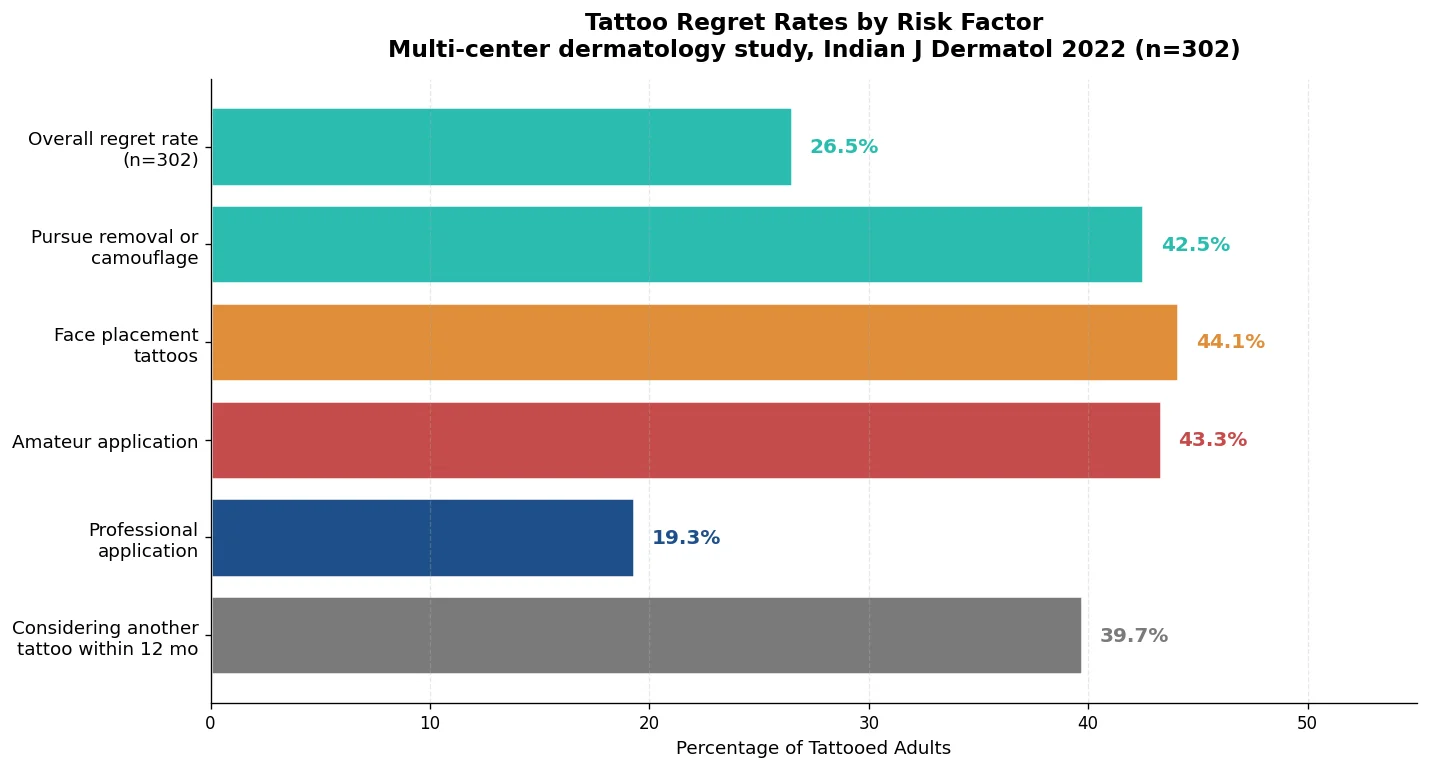
Tattoo regret is one of the most common reasons new patients walk into Perfect B in Doral asking about laser removal. The feeling rarely shows up in a single moment. It builds quietly across years, after a breakup, a career shift, a pregnancy, or simply when a piece stops feeling like the person wearing it. Independent peer reviewed dermatology research backs up what we see clinically: a 2022 multi-center study in the Indian Journal of Dermatology (Altunay et al., n=302) reported that 26.5 percent of tattooed adults regret at least one tattoo and 42.5 percent of that group ends up pursuing removal or camouflage. That external figure is far more specific than the older 75 percent number that still circulates in lifestyle media. The rest of this guide uses that 2022 peer reviewed dataset, along with the clinical pathway we follow at our Doral clinic, to break down the real prevalence, who is most affected, when regret tends to surface, and what supervised removal actually involves in South Florida.

How Common Is Tattoo Regret, Really?
The honest answer to how many people regret tattoos depends entirely on which year of data you trust. The most cited figure on social media still comes from a 2012 Harris Poll that put regret at roughly 23 percent in the United States, which an earlier Healthline review summarizing the 2012 Harris Poll on tattoo regret in the United States walks through in detail. Useful as a baseline, but more than a decade old. The question of how many people regret tattoos in 2026 needs a fresher dataset.
The 2022 study is the more reliable current source. A 2022 multi-center dermatology study in the Indian Journal of Dermatology finding that 26.5 percent of tattooed adults regret at least one tattoo and 42.5 percent of those pursue removal or camouflage updated the picture with a larger and more clinically observed sample. So when patients ask do people regret tattoos at the rates the internet claims, the answer is nuanced. About 1 in 4 tattooed adults report some degree of regret, and roughly 4 in 10 of those move toward removal or cover up. That is meaningful, but it is not the 75 percent figure that gets recycled in viral posts. The difference matters because patients who walk in believing they are an outlier feel ashamed. They are not. So do people regret tattoos at meaningful rates? Yes. Regret is a common, well documented response, and it is treatable.
When Does Tattoo Regret Usually Start? Immediate Shock vs One-Year vs Long-Term
Regret is not a single event. It has phases, and recognizing which phase you are in matters before you book any procedure. The first phase is acute tattoo shock, usually within the first 2 to 8 weeks. The skin is still healing, the ink looks darker and harsher than it will once it settles, and your nervous system is processing a permanent change to your body. Many patients who say “i regret my tattoo” at this stage are actually responding to the visual intensity of fresh ink, not the design itself.
The second phase shows up around the one year mark. Published data places sustained regret at roughly 21 percent at 1 year post-tattoo, with the rate climbing to about 36 percent several years out. By the time a patient walks into Perfect B saying “i regret my tattoo” three or four years after the fact, the feeling is rarely impulsive. It is usually tied to a life change: a new job, a divorce, a religious or cultural shift, or simply maturing taste. The clinical implication is straightforward. If you ask how many people regret tattoos and never act on it, the answer is most of them in the acute window. If you are inside the first 6 to 8 weeks, wait. If you are past one year and the feeling is stable or growing, the regret is real and worth addressing with a proper plan.
The Seven Most Common Reasons People Come to Perfect B Asking About Removal
Across the patients we see in South Florida, the reasons people pursue removal cluster into a small number of recurring patterns. When patients ask do people regret tattoos for predictable reasons or random ones, the answer is predictable. Recognizing your own pattern helps the consultation move faster and the treatment plan land closer to your real goal.
- Ex-partner name or initials: The single most common removal request. The tattoo is a daily reminder that complicates new relationships and personal closure.
- Visible placement that limits career options: Neck, hand, and face tattoos that were fine in one industry become a barrier when patients pivot to client-facing, medical, legal, or aviation roles.
- Poor design or artist quality: Blown out line work, muddy color, asymmetry, or a piece that did not age the way the artist promised. This drives many tattoo cover up vs removal questions.
- Identity shift: Tattoos picked at 18 to 22 often do not match the person at 30. The art is fine, the meaning is gone.
- Cultural or religious change: Conversion, return to faith, or family or community expectations that conflict with visible ink.
- Faded line work and unreadable detail: Older tattoos that have blurred into a gray smear. Patients often want a clean slate before deciding on new work.
- Impulse or intoxicated decisions: Tattoos done on vacation, at a party, or under the influence. Regret typically arrives within weeks and stabilizes within the first year.
Most patients arrive with a mix of two or three of these. The clinical question is never “is your reason valid.” It is whether the tattoo, in its current state, is a good candidate for laser removal, for a cover up, or for a combination of lightening sessions followed by new work.
Who Is Most Likely to Regret a Tattoo? What the 2022 Study Found
The 2022 multi-center data is unusually specific about who reports tattoo regret, and the demographic signal is strong enough to be clinically useful. When patients ask do people regret tattoos at random or is there a pattern, the answer is clear: there is a pattern.
- Age at first tattoo: Mean age 19.3 years in the regret group versus 22.7 years in the no-regret group. Three years of additional life experience meaningfully lowers regret risk.
- Amateur versus professional work: 43.3 percent of patients with amateur or unlicensed tattoos report regret, compared to 19.3 percent of those with professional work. More than double the risk.
- Placement: Face tattoos show the highest regret rate at 44.1 percent. Hand, neck, and forearm follow.
- Gender: 66.3 percent of regret reports in the study came from male respondents, though female regret is climbing in newer cohorts.
- Motivation: Fashion or peer-driven tattoos showed the highest regret rate. Memorial, identity, and meaning-driven tattoos showed the lowest.
None of these factors guarantee regret, and none of them rule it out. But they do explain why this regret skews younger, more male, and more amateur than the general tattooed population. Understanding your own risk profile is also useful if you are deciding whether new ink is a good idea right now, or whether you should wait.
Cover-Up vs Laser Removal: How to Decide Which Path Fits Your Tattoo
The tattoo cover up vs removal decision is the most frequent question we field at Perfect B. The right answer is rarely ideological. It depends on six concrete variables, and a competent consultation walks through each one before recommending a direction.
- Size of the original piece: Cover up artists typically need a new design 1.5 to 2 times the size of the existing tattoo. If you want to stay small, removal or partial fading is the better path.
- Color load: Heavy black ink is hard to cover with lighter colors. Multicolor pieces with red, yellow, and white are also difficult to mask. Laser lightening first, then cover up, often outperforms a direct cover up.
- Age of the tattoo: Older, faded ink covers more easily. Fresh, dense work is the hardest to hide with new art.
- Fitzpatrick skin type: Darker skin tones require careful laser parameters, which influences the tattoo cover up vs removal balance because aggressive laser settings carry higher pigment risk.
- Placement and movement: High-movement areas like fingers, wrists, and ankles fade laser results faster and limit cover up design options.
- Layered ink history: Tattoos that have already been touched up or covered once are denser and respond more slowly to laser. The tattoo cover up vs removal calculation shifts when you are dealing with two or three layers of pigment.
For a deeper breakdown of the tattoo cover up vs removal trade-offs by piece, see our clinical guide comparing tattoo cover-up versus laser removal and how to choose.
How Laser Tattoo Removal Works When You Have Fitzpatrick III to VI Skin
This is the section most general-interest articles skip, and it is the one that matters most for the Hispanic and Latino population we serve in Doral and Miami. Fitzpatrick III, IV, V, and VI skin contains significantly more melanin than the Fitzpatrick I and II skin that most early laser tattoo removal studies were built around. That changes the physics.
The core risk in darker skin is post-inflammatory hyperpigmentation, or PIH, where the laser energy is absorbed by skin melanin instead of tattoo ink. This can leave a temporary or, less commonly, persistent dark spot that is sometimes worse than the original tattoo. Avoiding it is a matter of wavelength selection, pulse duration, fluence, and cooling protocol. For Fitzpatrick III to VI skin, a 1064 nm Nd:YAG wavelength is the standard of care because it bypasses surface melanin more efficiently than the 532 nm or 755 nm wavelengths used for lighter skin and brighter ink colors. Picosecond pulse durations, contact cooling, and conservative starting fluences with mandatory test spots further reduce risk.
At Perfect B in Doral, every new laser tattoo removal patient with Fitzpatrick III or higher skin receives a test-spot protocol before the first full session. For a full clinical walkthrough, see a complete explainer of how laser tattoo removal works at the cellular level. The short version: the laser shatters ink particles into fragments small enough for your immune system to clear over several weeks. That clearance time is the reason sessions are spaced 6 to 8 weeks apart, not because the clinic is slow.

How Many Sessions and What It Costs at Perfect B in Doral
Honest answer first: nobody can quote you a final session count from a photo. The Kirby-Desai scale is the clinical tool used to estimate sessions, and it weights six variables including skin type, ink location, ink color, ink density, scarring, and layering. For a typical black-ink professional tattoo on Fitzpatrick III or IV skin, 8 to 12 sessions spaced 6 to 8 weeks apart is a realistic range. Patients often ask how many people regret tattoos and then need this many sessions: the two questions are linked because amateur tattoos drive both higher regret and faster clearance. Amateur tattoos often clear in fewer sessions because the ink sits more superficially. Multicolor tattoos with red, green, and blue components usually require more sessions and sometimes a second wavelength.
For current per-session pricing, package options, and what is included in your initial evaluation, see our supervised laser tattoo removal program at Perfect B in Doral. Pricing is best confirmed during a real consultation because the variables above shift the total cost significantly.
What to Do This Week If You Are Regretting a Tattoo
If you woke up this morning thinking “i regret my tattoo,” here is a practical sequence that respects both the clinical timeline and your peace of mind.
- If the tattoo is less than 8 weeks old: Wait. Acute tattoo shock resolves for most patients during this window. Booking laser removal now is premature.
- If the tattoo is older than 8 weeks and the feeling is stable: Book a consultation. Bring clear, well-lit photos of the tattoo from multiple angles, the approximate age of the piece, and whether it has been touched up or covered before.
- Confirm the clinic is medically supervised: Strip-mall laser shops without physician oversight carry higher pigment and scarring risk on Fitzpatrick III to VI skin. See what defines a supervised medical laser tattoo removal clinic in Doral and South Florida.
- Decide your end state before your first session: Full removal, fade for cover up, or partial removal of one element. That choice changes the number of sessions and the fluence settings.
Frequently Asked Questions
1. Is it normal to feel regret after a tattoo?
Yes. Acute tattoo shock in the first 2 to 8 weeks is extremely common, even when the patient ultimately loves the piece. The skin is healing, the ink looks more saturated than it will in three months, and your brain is processing a permanent change. Wait through that window before making any removal decision.
2. What is the regret rate for tattoos in 2026?
The most current peer-reviewed figure is 26.5 percent of tattooed adults reporting regret of at least one tattoo, from the 2022 Indian Journal of Dermatology multi-center study. The older 75 percent figure circulating online is not supported by current data.
3. How do I know if I have tattoo regret or just immediate tattoo shock?
Timing is the cleanest signal. Tattoo shock peaks in the first 2 to 8 weeks and softens as the skin heals and the ink settles. If the feeling is still present or growing 6 to 12 months later, it has crossed into sustained regret and is worth addressing clinically.
4. How many people regret tattoos and end up getting them removed?
Of the 26.5 percent who report regret, roughly 42.5 percent actively pursue removal or cover up, according to the 2022 study. That puts the share of tattooed adults who eventually act on regret at around 11 percent.
5. Should I get a cover-up or laser removal?
It depends on size, color load, age, placement, skin type, and how many ink layers are already in place. Heavy black or multicolor pieces often need laser lightening first, then a cover up. Small, faded, single-color pieces are usually good candidates for direct removal or a clean cover up.
6. Does tattoo regret go away over time?
Sometimes. Many patients who said i regret my tattoo at week two no longer feel that way at month six. Acute shock fades for most people. Sustained regret at one year or later tends to remain stable or grow, especially when the tattoo is tied to an ex-partner, a former identity, or a career limitation. Data shows about 21 percent of patients still report regret at 1 year and roughly 36 percent several years out.
Closing: The Doral Bottom Line on Tattoo Regret and Your Next Step
Tattoo regret is real, measurable, and far more specific than the headline statistics suggest. About 1 in 4 tattooed adults will feel it, the risk concentrates in patients who got inked young, chose amateur work, or picked a visible placement, and roughly 4 in 10 of those who regret will eventually act on it. The honest clinical question is never whether your regret is valid. It is whether the tattoo in front of us is best served by laser removal, by a fade-and-cover sequence, or by waiting another six months while the acute response settles.
The decision that matters most in South Florida is where you have the work done. Supervised medical laser tattoo removal, with a physician-led protocol, proper wavelength selection for Fitzpatrick III to VI skin, and mandatory test spots, is a different procedure than the same words at an unsupervised strip-mall shop. The equipment overlaps. The clinical judgment does not. If you are taking the time to research tattoo regret seriously, take the same care with where you book the consultation.
- 📍 Visit us at Perfect B | 3905 NW 107th Ave, Suite 104, Doral FL 33178
- 📞 Call or message us at (786) 502-2260
- 💳 Buy Now Pay Later available: Cherry, Klarna, Afterpay, CareCredit