
Perfect B, Doral Fl. | 05.27.26 | 10 min read.
This post is for educational purposes only and does not substitute for personalized medical advice. Individual results and healing vary. Consult a licensed provider before beginning any laser treatment. This is one part of a larger plan, so see how laser tattoo removal is approached at Perfect B in Doral and what to expect across a full course of sessions. For more on this, see our guide to Permanent Makeup Removal: Doral FL Clinic, and how it is evaluated and treated at Perfect B in Doral.
Does Laser Tattoo Removal Actually Cause Scarring? The Honest Answer
Scarring from laser tattoo removal is uncommon when the procedure is done correctly, but it is not impossible. The honest clinical answer is that scarring occurs in a small percentage of cases, and when it does, it is almost always the result of identifiable and preventable factors. The laser itself, when used at the right settings for the patient’s skin type and ink density, does not damage the dermal structure that causes permanent scarring. What causes scarring is the combination of aftercare failures, skin type risk factors, sessions spaced too closely together, or pre-existing scar tissue from the original tattoo application. Related reading: Tattoo Removal Breastfeeding: Doral Clinic Guide, and how it is evaluated and treated at Perfect B in Doral.
This distinction matters because patients searching for whether tattoo removal leaves scarring often encounter two unhelpful extremes. One category reassures with “scarring is extremely rare” without explaining what makes it rare or who faces higher risk. The other documents alarming cases without context. This post explains the actual mechanism behind tattoo removal scarring, identifies the four root causes, and walks through what a medical clinic can do to minimize risk, including what to do if scarring has already occurred.
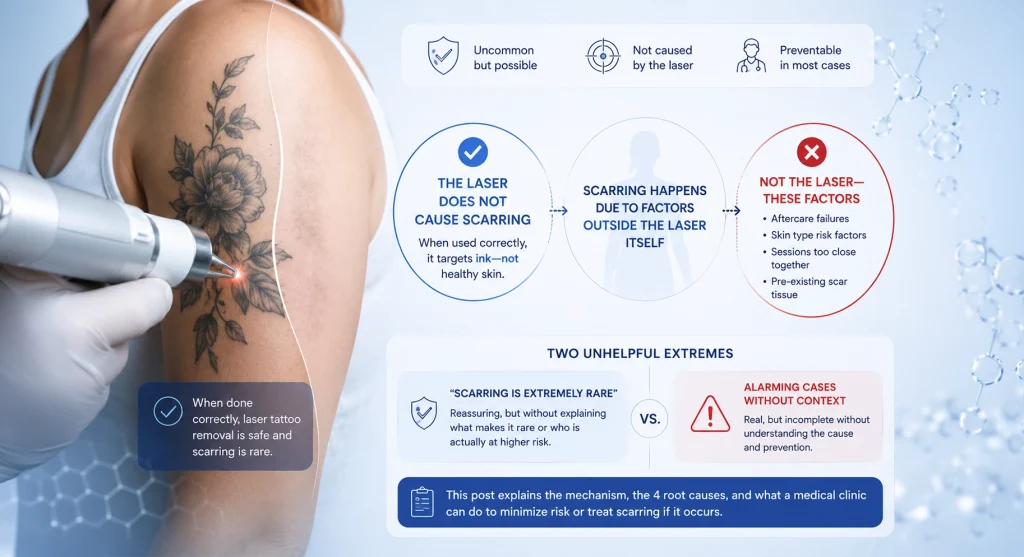
Key Takeaways on Scarring From Laser Tattoo Removal
- Scarring from laser tattoo removal is rare but preventable. The primary causes are picking or popping blisters, sessions scheduled too close together, UV exposure during healing, and pre-existing scar tissue in the original tattoo.
- Laser technology does not inherently scar skin when used correctly. Modern picosecond lasers like the PiQo4 fragment ink without the excessive thermal damage that older Q-switch lasers produced.
- Fitzpatrick IV through VI skin tones face higher risk of post-inflammatory changes and keloid formation after scarring from laser tattoo removal, making proper laser settings and aftercare especially critical for South Florida patients.
- Pre-existing scar tissue from a poorly applied tattoo can remain visible after the ink is removed. Patients should be counseled about this risk before starting a removal series.
- If scarring has already occurred, a licensed medical provider can treat it with silicone therapy, corticosteroid injections, fractional laser resurfacing, or pulsed dye laser, depending on the type and severity.
Why Scarring Happens: The 4 Root Causes Behind Tattoo Removal Scars
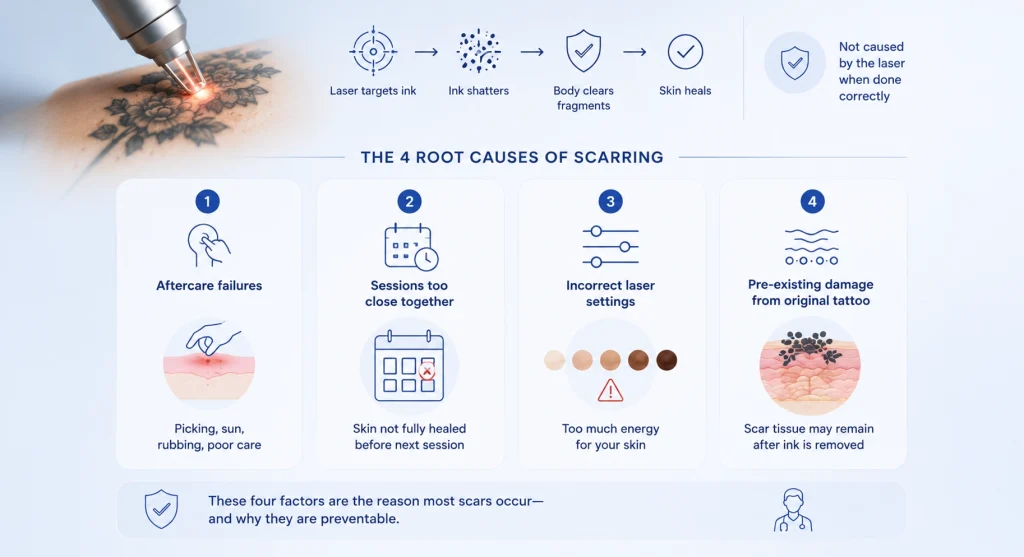
Understanding why scarring from laser tattoo removal occurs requires understanding how the laser interacts with skin. The laser does not cut or abrade the skin surface. It delivers concentrated energy pulses that pass through the outer skin layers and target ink particles in the dermis. The ink absorbs the energy, heats rapidly, and shatters into microscopic fragments the lymphatic system can clear. In a properly calibrated treatment, surrounding skin tissue experiences minimal disruption. The four causes of scarring all represent departures from this optimal process.
- Cause 1: Patient aftercare failures. The most common cause of tattoo removal scarring is patient behavior after a session. Picking or popping blisters, peeling scabs, rubbing the treatment area, and sun exposure during healing are all direct pathways to scar formation. The skin over the treatment area is temporarily compromised, and any mechanical disruption to healing tissue can trigger the fibrotic response that produces a scar.
- Cause 2: Sessions scheduled too close together. The 6 to 8 week minimum between sessions exists for clinical reasons. Skin treated before the previous session has fully healed is in a fragile state. Applying laser energy to incompletely healed skin increases thermal load on tissue that cannot fully absorb it, raising the probability of scarring. At Perfect B in Doral, we enforce session spacing as a clinical standard.
- Cause 3: Incorrect laser settings for the patient’s skin type. Fluence that is too high for a given skin tone or ink density delivers excess thermal energy to the surrounding dermis. This is especially relevant for Fitzpatrick IV through VI skin tones, which absorb more laser energy in the melanin of the epidermis, increasing the thermal burden on the skin surface. A qualified provider calibrates laser settings to each patient’s specific parameters at every session.
- Cause 4: Pre-existing damage from the original tattoo application. Some tattoos were applied by artists who went too deep into the dermis, already causing scar tissue formation before any laser treatment began. This scar tissue is embedded beneath the ink. When the ink is removed, the underlying scar structure becomes visible. This is not a complication of the removal process. It is a pre-existing condition the laser cannot reverse.
A peer-reviewed study in the Journal of Cutaneous and Aesthetic Surgery confirming that adverse effects including hyperpigmentation, hypopigmentation, and textural changes in laser tattoo removal are most consistently linked to incorrect fluence settings, inadequate session spacing, and post-treatment sun exposure rather than to the laser procedure itself reflects exactly the framework we apply at Perfect B when managing scarring risk across all skin types.
The Scar You Already Had: Pre-Existing Scar Tissue From the Original Tattoo
One of the most important and least discussed aspects of tattoo removal scarring is the role of pre-existing damage. When a tattoo artist places the needle too deeply into the dermis, or makes repeated passes over the same area, the application process itself creates scar tissue. This fibrous tissue forms beneath and around the ink. The patient may have had it for years without knowing it because the tattoo ink visually masked the texture and tone differences that would make a scar visible on untattooed skin.
At our clinic in Doral, we identify this during the initial consultation. We look for raised texture, uneven surface tension, or thickened areas within the tattooed zone. When we find them, we explain before the first session that the ink can be removed but the underlying tissue structure was altered before the patient ever came in for laser treatment. This is not a failure of the removal process. It is a pre-existing condition, and patients deserve to understand the distinction so their expectations are calibrated correctly. In these cases, a scar treatment plan may run in parallel with or after the removal series.
Who Faces Higher Risk for Scarring After Laser Tattoo Removal
Not all patients carry the same scarring risk. The chart below maps the relative contribution of each factor based on clinical evidence and our experience treating patients in South Florida. Several of the highest-risk factors are directly within the patient’s control. The biological risk factors require provider-side calibration.
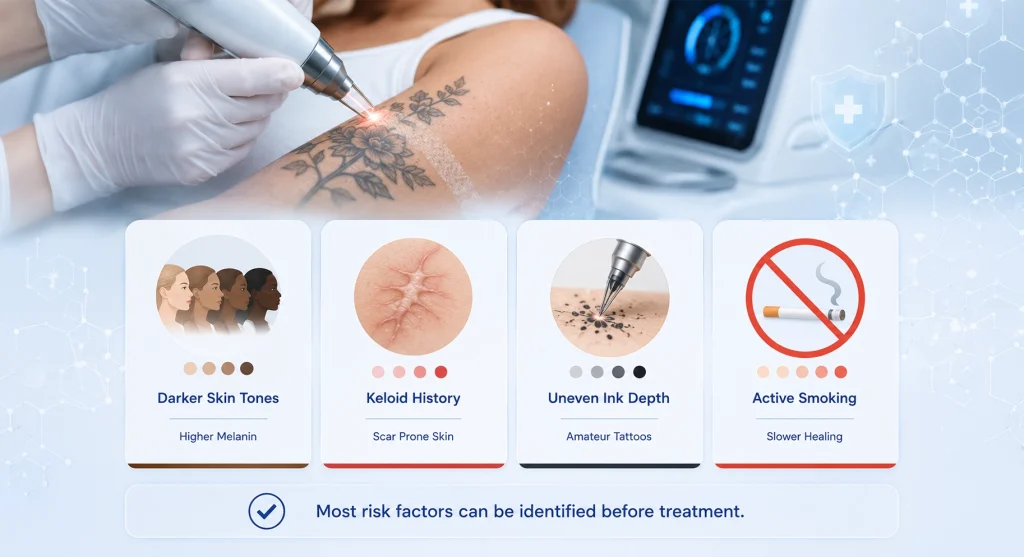
- Fitzpatrick IV through VI skin tones. Patients with higher melanin concentrations absorb more laser energy in the epidermis. When settings are not adjusted for this, the surface skin experiences more heat than intended, increasing the risk of post-inflammatory hyperpigmentation and textural changes. For our patient population in Doral and South Florida, which includes a large proportion of Latin American, Caribbean, and South American patients with Fitzpatrick III through V skin tones, this is a clinical factor we address at every session. → Read how Perfect B approaches laser tattoo removal for dark skin tones in Miami, including the specific fluence adjustments and session spacing protocols that reduce scarring and hyperpigmentation risk for Fitzpatrick IV and V patients.
- History of keloid formation. Patients who have formed keloids from prior injuries, piercings, or surgeries are at elevated risk of keloid development at treated areas. This is a contraindication that must be identified before treatment begins. Keloid-prone patients can still be treated but require a modified protocol and close monitoring.
- Amateur tattoos with uneven ink depth. Professionally applied tattoos tend to have consistent ink depth. Amateur tattoos often do not. Areas of deeper ink penetration require more energy to fragment, creating uneven heating patterns across the treatment zone that increase localized risk.
- Active smoking. Nicotine impairs wound healing by reducing peripheral circulation and oxygen delivery to healing tissue. Research on laser tattoo removal outcomes consistently identifies smoking as a factor that slows healing, reduces ink clearance, and increases the risk of complications including scarring.
8 Things That Prevent Scarring After Laser Tattoo Removal
Most scarring from laser tattoo removal is preventable. Eight specific behaviors and protocols account for the vast majority of risk reduction. The first four are patient-controlled. The last four require provider coordination.
- 1. Never pick, pop, or scratch blisters or scabs. Blisters are a normal healing response to laser energy. They reabsorb on their own within 7 to 14 days. Popping or scratching them removes the skin’s natural protective layer over actively healing tissue and introduces infection risk and mechanical trauma, both of which directly trigger scar formation. This is the single most controllable risk factor.
- 2. Apply Aquaphor or petroleum jelly consistently in the first week. Keeping the treatment area moist during the initial healing phase supports epithelial recovery and prevents the dryness and cracking that can interfere with clean tissue closure. Apply a thin layer after every cleaning, twice daily, for the full first week.
- 3. Block all sun exposure to the treatment area for the entire series. UV radiation on healing or recently healed laser-treated skin is a primary driver of post-inflammatory hyperpigmentation, which in darker skin tones can persist for months. In Miami, where UV index is among the highest in the continental United States year-round, SPF 50 or higher applied daily to the treatment site is mandatory from week 2 of each session cycle through the completion of the series.
- 4. Wait the full 6 to 8 weeks between sessions. The interval is not optional. It allows the lymphatic system to process and clear fragmented ink from the previous session and gives skin time to complete its full healing cycle. Rushing sessions is one of the most common causes of tattoo removal scarring in under-supervised or high-volume chain clinic settings. → Read the Perfect B session guide to understand how ink color, tattoo depth, skin tone, and immune response determine the number and spacing of sessions for your specific removal timeline.
- 5. Disclose your full skin and medical history before treatment. Keloid history, autoimmune conditions, active skin infections, current medications including retinoids and photosensitizing drugs, and recent significant sun exposure all affect how skin responds to laser energy. A provider who does not ask these questions before treating is not providing a safe standard of care.
- 6. Request that the provider calibrate settings to your skin tone at each session. Fluence and pulse duration should be adjusted based on real-time skin response, not applied uniformly. A blanched reaction to the laser during treatment is a normal frosting response. Immediate blistering beyond the frosting, excessive redness spreading beyond the tattoo border, or burning pain after the session ends are signals that settings were too aggressive.
- 7. Follow the between-session care protocol specific to Miami’s climate. Standard post-care instructions written for cooler markets do not account for Miami’s heat, humidity, and UV intensity. Avoid any exercise that causes active sweating at the treatment site for 72 hours post-session, and shower immediately after physical activity during the first two weeks of healing. → Read Perfect B’s full aftercare guide for laser tattoo removal in Miami, including the specific modifications required for South Florida’s heat, humidity, and UV environment that standard clinic guides overlook.
- 8. Report any abnormal healing signs to your provider immediately. Increasing pain after 48 hours, expanding redness beyond the treatment zone, discharge, fever, or blisters growing rather than resolving after day 5 are signs of complications requiring prompt clinical assessment. Do not manage these at home or wait for the next scheduled appointment.
Blistering After Laser Tattoo Removal: What Is Normal and When to Call Your Clinic
Blistering is one of the most anxiety-producing aspects of tattoo removal healing because patients who have not seen it before assume it signals something went wrong. In most cases, it signals the opposite. Blisters form when laser energy causes rapid heating in the superficial dermis and fluid accumulates between tissue layers as part of the acute inflammatory response. They are most common on areas with dense, saturated ink because higher ink concentrations require more energy to fragment.
Normal blistering: what it looks like and how to manage it
Normal blisters appear within 24 to 48 hours of treatment, are fluid-filled and clear or slightly white, reach their maximum size by day 2 to 4, and then gradually flatten and reabsorb over 7 to 14 days. They should not be painful beyond mild pressure sensitivity. They should not increase in size after day 4. Management is hands-off: keep the area clean, apply a thin layer of Aquaphor over intact blisters, and cover loosely with non-stick gauze. Do not pop, scratch, or apply any active skincare ingredients to the area.
Signs that require immediate clinical attention
Contact your provider if you experience: blisters that continue enlarging after day 5, blisters that rupture and produce cloudy, yellow, or green discharge, skin that appears white or grayish and does not return to normal color within 48 hours of treatment, pain that increases rather than decreases after the first 48 hours, fever above 100.4 degrees Fahrenheit, redness that expands significantly beyond the treatment zone border, or any area of the treatment site that develops a hard, raised, or unusually firm texture within the first two weeks. These are uncommon findings when aftercare is followed correctly, but they are clinically significant and should not be observed at home.
What a Medical Clinic Does If Scarring Has Already Occurred
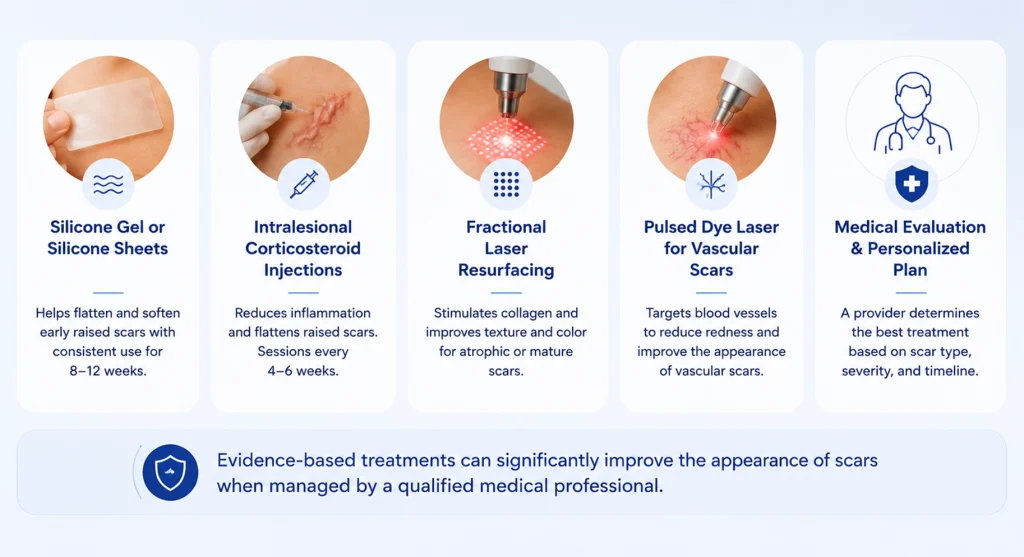
If scarring has occurred after tattoo removal, the appropriate response depends on the type, severity, and timeline of the scar. A medical provider evaluates scar texture, color, pliability, and depth before recommending a treatment path. The most common interventions available at a medical aesthetic clinic are:
- Silicone gel or silicone sheets. For early hypertrophic or raised scars, silicone-based products applied consistently for 8 to 12 weeks are a first-line treatment that flattens and softens scar tissue. This is a patient-managed intervention that works through hydration of the stratum corneum and regulation of growth factor activity in the scar. Clinical data supporting silicone therapy for hypertrophic scarring is among the strongest in the scar management literature.
- Intralesional corticosteroid injections. For established hypertrophic scars or early keloid activity, corticosteroid injections directly into the scar tissue suppress inflammation, reduce collagen overproduction, and flatten the raised scar. Sessions are typically spaced 4 to 6 weeks apart and require a licensed medical provider to administer.
- Fractional laser resurfacing. For atrophic or depressed scarring and for mature hypertrophic scars that have not responded to silicone therapy, fractional laser resurfacing stimulates new collagen formation, remodels the scar matrix, and improves both texture and color. At Perfect B in Doral, fractional resurfacing is integrated into our scar reduction treatment plan as a second-line intervention for post-tattoo-removal scarring.
- Pulsed dye laser for vascular scars. For scars with a persistent red or pink vascular component, pulsed dye laser targets the hemoglobin in the abnormal blood vessels feeding the scar, reducing redness and improving overall appearance. This is particularly relevant for patients whose scars developed within the first few months after tattoo removal.
A peer-reviewed review in Dermatologic Surgery reviewing evidence-based options for hypertrophic scar and keloid management, confirming that intralesional corticosteroids and silicone-based therapies remain the highest-evidence first-line interventions for post-laser scarring provides the clinical foundation for the protocol we follow at Perfect B when managing this complication.
How PiQo4 Technology at Perfect B Reduces Scarring Risk Compared to Older Lasers
Not all laser tattoo removal technology carries the same scarring risk profile. The PiQo4 laser used at Perfect B operates in both nanosecond and picosecond pulse modes and delivers energy across four wavelengths: 532 nm, 650 nm, 585 nm, and 1064 nm. This multi-wavelength capability means the laser can be matched to specific ink colors and skin tones with precision that single-wavelength or dual-wavelength systems cannot offer.
The picosecond pulse duration is clinically significant for scarring risk. Older Q-switch nanosecond lasers deliver energy in pulses measured in nanoseconds. The PiQo4 delivers in picoseconds, meaning the energy is deposited so rapidly that it fractures the ink particle photomechanically rather than primarily through heat. Less heat delivered to surrounding tissue means a lower thermal injury footprint per session, which is the primary mechanism by which modern picosecond lasers produce fewer thermal complications including scarring from laser tattoo removal. For Fitzpatrick IV and V patients, which represents a significant proportion of patients seeking tattoo removal in Miami and Doral, the reduced thermal burden per pulse is a clinically meaningful difference.
Frequently Asked Questions
1. Does laser tattoo removal leave scars?
Scarring from laser tattoo removal is uncommon when the procedure is performed by a qualified provider at appropriate settings and the patient follows aftercare instructions. The most common causes of scarring are picking or popping blisters, sessions scheduled too close together, and UV exposure during healing. When these factors are controlled, the vast majority of patients complete a full removal series without any permanent textural change to the skin.
2. Does tattoo removal leave scarring more often on dark skin?
Patients with Fitzpatrick IV through VI skin tones are at higher risk for post-inflammatory hyperpigmentation and keloid formation if laser settings are not calibrated appropriately for their skin tone. This is a provider-side risk factor, not an inherent limitation of the patient. At Perfect B in Doral, where the majority of patients have Fitzpatrick III through V skin, every session involves specific fluence and pulse adjustments designed for melanin-rich skin. Properly managed, patients with darker skin tones can achieve excellent removal outcomes without scarring.
3. Can tattoo removal cause scarring if I follow all the aftercare instructions?
If aftercare is followed correctly and the laser settings were appropriate for your skin, scarring is very unlikely. The remaining risk factors are biological: keloid-prone skin, pre-existing scar tissue in the tattoo, or a very unusual individual healing response. These are identifiable at the consultation stage. A thorough intake process should flag these before treatment begins so expectations and protocols can be adjusted accordingly.
4. What does scarring from tattoo removal look like?
Post-tattoo-removal scarring most commonly appears as raised, thickened, or discolored skin in the treated area, either hypertrophic or hypopigmented. Some patients develop a textural change where the skin appears smoother or shinier than surrounding tissue. In patients who had pre-existing scar tissue from the original tattoo, the underlying scar structure may become more visible once the covering ink is removed.
5. How long after tattoo removal can scarring appear?
Most visible scarring after laser tattoo removal develops in the first 2 to 6 weeks following a session. Early hypertrophic changes can appear in the first 6 to 8 weeks. Keloids, in patients prone to them, may continue developing for months. If the skin returns to a normal, flat appearance by 8 to 12 weeks after a session, permanent scarring is unlikely. Persistent raised texture or color change beyond 12 weeks warrants clinical evaluation.
6. Can a scar from tattoo removal be treated?
Yes. Most post-tattoo-removal scars respond to treatment when addressed early. First-line options are silicone gel or silicone sheets applied consistently for 8 to 12 weeks. Established hypertrophic scars or early keloid activity can be managed with intralesional corticosteroid injections. Fractional laser resurfacing is effective for improving scar texture and color in mature scars. A licensed medical provider evaluates scar type before recommending a specific intervention. Call us at (786) 502-2260 if you are dealing with a post-removal scar and need a clinical evaluation.
7. Is the scarring risk different at a medical clinic versus a tattoo shop or spa?
Yes, meaningfully so. At a medical clinic, a licensed provider evaluates your skin type, medical history, and keloid risk before selecting laser settings. Settings are adjusted per session based on the skin’s real-time response. At non-medical settings, these calibrations may not occur. Scarring from laser tattoo removal is disproportionately associated with treatments performed outside supervised medical settings.
The Clinic Takeaway: Scarring From Laser Tattoo Removal Is Mostly Preventable
The clinical picture on scarring from laser tattoo removal is clear. The laser itself, calibrated correctly, does not cause permanent skin damage. What causes scarring is the failure of one or more safeguards: aftercare neglect, compressed session spacing, mismatched laser settings, or unaddressed pre-existing risk factors. Each of these is addressable before it becomes a problem. The provider’s job is to identify biological risk, calibrate technology appropriately, and give the patient accurate expectations. The patient’s job is to follow the aftercare protocol and report any healing anomalies promptly. When both sides of that equation are met, the outcomes are consistently clean.
At Perfect B in Doral, the patients most likely to have a complication-free removal series are those who understood the risk factors before the first session, followed the aftercare protocol in Miami’s high-UV climate, and were treated with laser settings specific to their skin tone. If you are evaluating whether to start a removal series, or if you are currently in a series and have questions about how your healing looks, a consultation at a medical clinic is where those questions belong.
- 📍 Visit us at Perfect B, Doral FL, serving Miami and South Florida patients seeking laser tattoo removal.
- 📞 Call or message us at (786) 502-2260 to schedule your tattoo removal consultation with a licensed medical provider.