Perfect B, Doral Fl. | 06.22.26 | 12 min read.
This article is for educational purposes only and is not a substitute for medical advice, diagnosis, or treatment. Treatment results vary by patient. Speak with a licensed medical provider before starting any acne scar treatment plan.
Key Takeaways
- Acne scars cannot always be fully removed, but significant visible improvement is realistic for most patients, with a typical range of 60 to 90 percent improvement depending on the scar type.
- Scar type determines what is achievable. Boxcar, rolling, and pigmented marks respond best. Deep icepick scars are the most resistant to complete removal.
- Full removal is rare, but visible improvement is the goal. At Perfect B in Doral, FL we set the realistic target at 80 to 90 percent improvement across a staged treatment plan, not at zero remaining marks.
- Multiple sessions across several months are required. Atrophic structural scars typically need 4 to 7 sessions spaced 4 to 6 weeks apart, with the final result visible 3 to 6 months after the last treatment.
- The Perfect B protocol layers subcision, RF microneedling, ResurFx resurfacing, and regenerative additives like exosomes, PRP, and PDRN. We do not offer TCA CROSS at our Doral clinic.
Can Acne Scars Be Fully Removed? The Honest Answer
The shortest honest answer to can acne scars be fully removed is no, not in most cases, but significant improvement is realistic almost always. Across the major dermatology authorities (NHS, Cleveland Clinic, NIH peer-reviewed reviews), the consensus is that treatment can substantially improve the appearance of acne scars without erasing them entirely. The same is true at our clinic in Doral, FL. Where the patient experience differs is in the gap between expectation and result, which is the gap this article is written to close. Our deeper Perfect B pillar on how every acne scar type is staged and treated in Miami covers the underlying protocol that supports these realistic numbers.
Why Acne Scar Type Determines What Is Possible
The single biggest predictor of how much improvement a patient will see is the type of scar, not the choice of treatment device. A patient comparing two laser packages online without knowing whether their scars are icepick, boxcar, rolling, hypertrophic, or post-inflammatory is comparing prices for treatments that may not even apply to their case. Our detailed Perfect B guide identifying the four main types of acne scars and how each one is treated walks through this in depth.
Depth and Tethering Matter More Than the Device
Acne scars form when inflammatory acne damages the dermis. Some heal as depressions where the skin lost collagen (atrophic scars). Others heal as raised bumps where the body produced too much collagen (hypertrophic and keloid scars). And some leave only a color change without any change in skin texture (post-inflammatory hyperpigmentation or post-inflammatory erythema). The same energy-based device behaves differently on each of these categories. A laser that smooths boxcar scar walls does little for a deeply tethered rolling scar that needs the fibrous band underneath cut first.
Atrophic vs Hypertrophic Scars
Atrophic acne scars (icepick, boxcar, rolling) lose dermal volume. They are the most common type after inflammatory acne and the type most patients have in mind when they ask about removal. Hypertrophic and keloid scars are raised lesions where the body overcorrected during healing. These two categories are not treated the same way. Atrophic scars need volume rebuilding through collagen induction. Raised scars need volume reduction through intralesional steroids, pulsed dye laser, or steroid-laser combinations. Mixing the two strategies is a common reason patients see disappointing results from a single-device clinic.
What Responds Well and What Does Not, by Scar Type
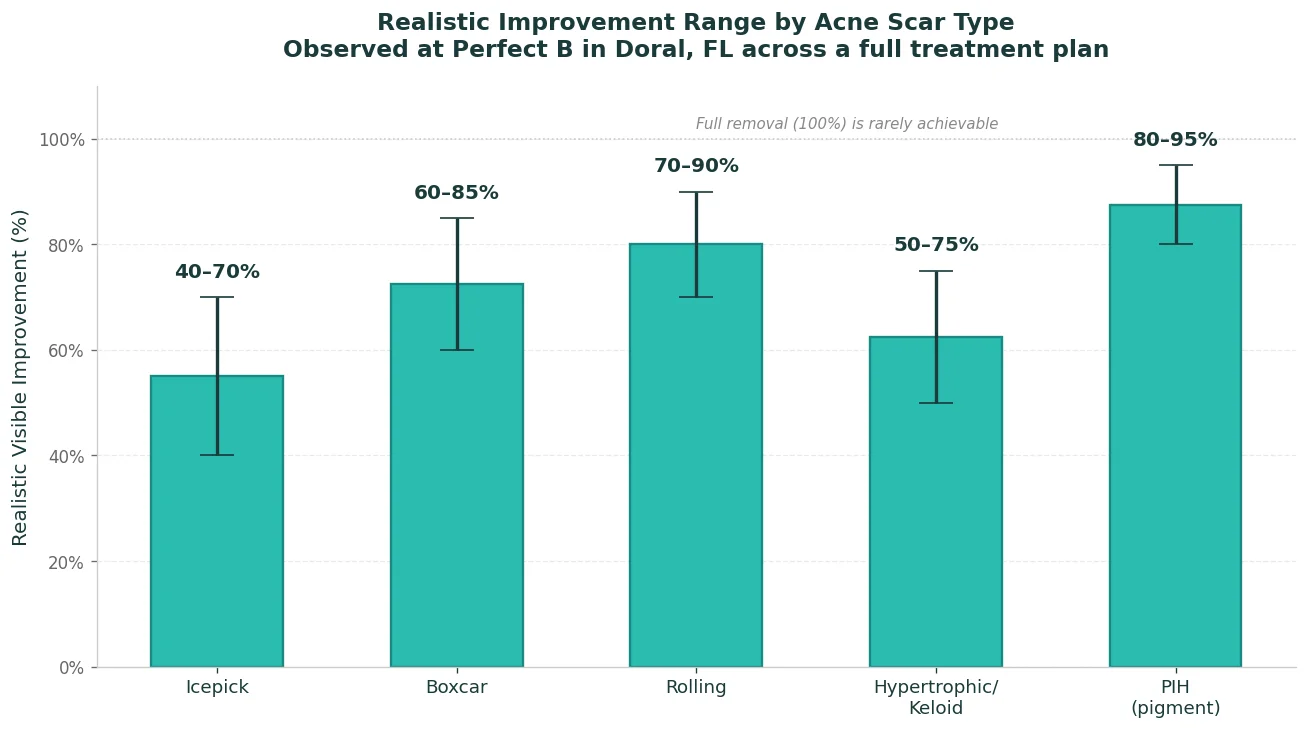
Realistic expectations are scar-type specific. The numbers below reflect typical visible improvement we observe at Perfect B in Doral across a complete staged treatment plan.
Icepick Scars: The Hardest to Treat
Icepick scars are narrow, deep punctures that often reach the deeper dermis or hypodermis. Their geometry (narrow opening, vertical depth) means that even aggressive resurfacing rarely reaches the base. Realistic expectation at Perfect B: 40 to 70 percent visible improvement across a full plan, with patients in the 50 to 60 percent range being typical. Full removal is uncommon. The Perfect B approach for icepick scars combines Morpheus8 RF microneedling at depth with subcision and regenerative add-ons. We do not offer TCA CROSS at our Doral clinic.
Boxcar Scars: Strong Responders to Layered Treatment
Boxcar scars are wider, shallow-to-medium depressions with sharp vertical edges. Because the walls are accessible and the depth is moderate, they respond well to combined RF microneedling and resurfacing. Realistic expectation: 60 to 85 percent visible improvement. Patients with shallow boxcars often reach the upper end of that range. Deep boxcars approach but rarely cross the 85 percent line.
Rolling Scars: Need the Tether Released First
Rolling scars are the broad, wave-like depressions caused by fibrous bands pulling the skin downward from beneath. Surface-only treatments leave rolling scars looking the same because the tether is still in place. Realistic expectation: 70 to 90 percent visible improvement when subcision is included to release the fibrous band, followed by collagen induction. Without subcision, rolling scars respond modestly to anything else.
Hypertrophic and Keloid Scars: Different Category Entirely
Hypertrophic and keloid scars are raised, not depressed. They require intralesional steroid injections (often serial), sometimes combined with pulsed dye laser to address vascularity. Realistic expectation: 50 to 75 percent reduction in height and redness. Keloids in particular have a meaningful recurrence rate even after successful treatment, which is why supervised follow-up matters.
Post-Inflammatory Hyperpigmentation (PIH): The Easiest Win
Most “scars” patients see after acne are not scars at all but post-inflammatory hyperpigmentation: brown or red marks where the skin took longer to settle. PIH is not a structural scar. Realistic expectation: 80 to 95 percent fading with appropriate chemical peels, topicals, and sun protection. Patients in Doral with Fitzpatrick IV skin frequently see this category resolve well when sun protection is consistent.
The Realistic Timeline at Perfect B in Doral
A common patient frustration is expecting visible improvement within weeks. Collagen remodeling takes months. The realistic timeline at our Doral clinic is 3 to 9 months of active treatment plus 3 to 6 additional months for the final collagen response to mature. Atrophic structural scars typically need 4 to 7 sessions spaced 4 to 6 weeks apart. Patients who follow the staged plan consistently see most of the improvement land between months 4 and 9. Our Perfect B clinical write-up on how Morpheus8 RF microneedling remodels the dermis and what patients actually experience between sessions explains why the wait between sessions matters as much as the sessions themselves.
What Makes Results Better or Worse
Two patients with the same scars can land at different points on the improvement range depending on factors that are partly clinical and partly behavioral. The factors below are the ones we see drive the gap.
Skin Type and Fitzpatrick Context
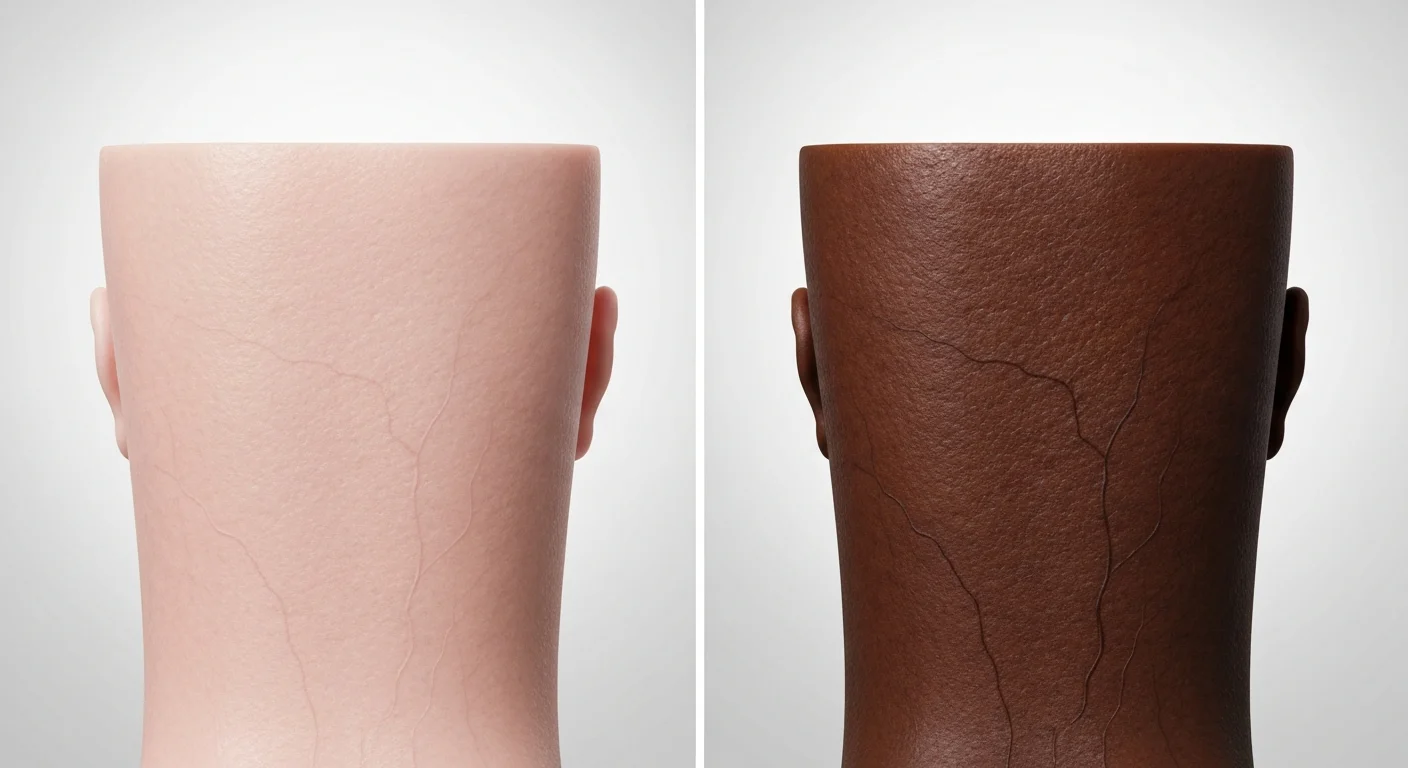
South Florida patients are heavily Fitzpatrick III through V. Higher Fitzpatrick types pigment more readily after aggressive resurfacing, which means treatment intensity has to be calibrated carefully. At Perfect B in Doral we adjust device settings, post-treatment pigment control, and sun protection guidance for patients with Hispanic and darker-skinned profiles. Patients who follow that adjusted protocol typically reach the same improvement range as lighter-skinned patients, just over a slightly longer timeline.
Age and Collagen Quality
Younger skin remodels faster. Patients in their twenties typically see results land sooner and at the upper end of the improvement range. Patients in their forties and fifties see the same improvement range but over a longer timeline because dermal collagen turnover slows with age. This is not a reason to delay treatment. It is a reason to plan for the full timeline.
Consistency and Aftercare
The factor that most often separates 60 percent improvement from 85 percent is whether the patient follows the home protocol between sessions. Daily sun protection, the topical regimen prescribed during the plan, and avoiding picking or aggressive exfoliation during the remodeling window matter as much as the in-office sessions. Patients who skip sun protection in South Florida often lose ground between sessions, especially with PIH.
How Perfect B Approaches Acne Scar Treatment in Doral, FL
The clinical framework used at our Doral clinic is structured around four sequential goals: Release, Remodel, Resurface, and Re-color. Our Perfect B clinical guide to microneedling for acne scars detailing collagen induction sessions and what to expect covers one of the core devices in this protocol.
Release: Subcision With Radiesse for Tethered Scars
Rolling and tethered boxcar scars start with subcision. A blunt cannula or specialized needle is passed beneath the scar to mechanically cut the fibrous bands pulling the skin downward. We pair subcision with Radiesse to provide collagen-inducing support during healing, which prevents the tether from re-forming.
Remodel: Morpheus8 RF Microneedling
RF microneedling delivers radiofrequency energy at calibrated depths to trigger collagen and elastin production from within the dermis. Morpheus8 is the device we use because it allows depth control suitable for Fitzpatrick IV and V skin. This step rebuilds dermal volume where atrophic scars lost it.
Resurface: ResurFx Non-Ablative Laser
ResurFx is a fractional non-ablative laser that refines the surface after the structural work. We use ResurFx rather than ablative CO2 because the recovery profile suits working professionals in Miami and because the pigment-safety profile is better for the Fitzpatrick range we treat most often.
Re-color: Chemical Peels and Topicals for PIH
Once structural scars are remodeled, residual pigment is treated with calibrated chemical peels and topical retinoid and tyrosinase-inhibitor combinations. This step is the easiest to skip and the one that most often determines whether the final result looks like a complete improvement or a partial one.
A note on TCA CROSS: the chemical reconstruction of skin scars (TCA CROSS) technique is mentioned in many online acne scar guides. Perfect B does not perform TCA CROSS at our Doral clinic. The protocols listed above are what we use instead and what the realistic improvement numbers in this article are based on.
Frequently Asked Questions
1. Can acne scars be 100 percent removed?
In most cases no. Full removal of acne scars is rare. Significant visible improvement is the realistic goal, with a typical range of 60 to 90 percent depending on the scar type. Boxcar, rolling, and post-inflammatory pigmentation respond best. Deep icepick scars are the most resistant.
2. Are acne scars permanent?
Atrophic acne scars (icepick, boxcar, rolling) are permanent structural changes in the dermis. They do not heal on their own without treatment. Post-inflammatory hyperpigmentation and post-inflammatory erythema, which are often mistaken for scars, are not permanent and frequently resolve with topical treatment, peels, and sun protection.
3. How long does it take to see acne scar improvement at Perfect B?
The active treatment plan typically runs 3 to 9 months across 4 to 7 sessions spaced 4 to 6 weeks apart. The final improvement matures 3 to 6 months after the last session because dermal collagen remodeling continues during that window. Patients in Doral, FL who follow the plan consistently see most of the improvement land between months 4 and 9.
4. How do I know if my acne scars are permanent or will fade on their own?
A simple test: stretch the skin around the mark gently. If the mark disappears when stretched, it is most likely post-inflammatory hyperpigmentation or erythema and may fade with time and topical treatment. If the indentation persists when stretched, it is a structural scar and will not resolve without professional treatment.
5. Does scar type really change the result that much?
Yes. The same treatment plan applied to a boxcar versus an icepick scar produces very different outcomes. That is why the first step at Perfect B is identifying the type and depth before recommending a plan. Treating a rolling scar without releasing the fibrous tether first, for example, leaves the patient with minimal improvement regardless of how many resurfacing sessions follow.
6. Is the Perfect B protocol different for darker skin tones?
Yes. South Florida patients are heavily Fitzpatrick III through V. We calibrate Morpheus8 depth and energy, choose ResurFx over more aggressive ablative options, and add a more deliberate pigment-control protocol to reduce the risk of post-inflammatory hyperpigmentation after sessions. The improvement range is the same, the timeline can be slightly longer.
7. Does Perfect B perform TCA CROSS for icepick scars?
No. We do not perform TCA CROSS at our Doral clinic. For icepick scars we use Morpheus8 RF microneedling at depth combined with subcision and regenerative additives like exosomes and PDRN. The realistic improvement range we cite for icepick scars (40 to 70 percent) reflects this protocol, not a TCA CROSS-based one.
Closing: What “Removed” Really Means
When patients ask whether acne scars can be fully removed, the underlying question is usually whether they can look in the mirror without seeing the scars. That is achievable for most patients, even when the scars themselves are not technically gone. An 80 to 90 percent visible improvement with smooth skin in normal light is a different result from chasing the last 10 percent and never reaching it. The realistic plan focuses on the first goal.
The honest framing of expectations matters more than the device list. At Perfect B in Doral, FL we set the target at significant improvement, identify the scar type accurately before quoting a plan, and follow through across the months the dermis needs to remodel. That is the path that produces consistent results for patients in Miami and across South Florida.
- 📍 Visit us at Perfect B, 3905 NW 107th Ave, Suite 104, Doral FL 33178
- 📞 Call or message us at (786) 502-2260
- 💳 Financing available through Cherry, Klarna, Afterpay, and CareCredit